
Common Roof Pitches: A Chart of Degrees, Ratio & Percent
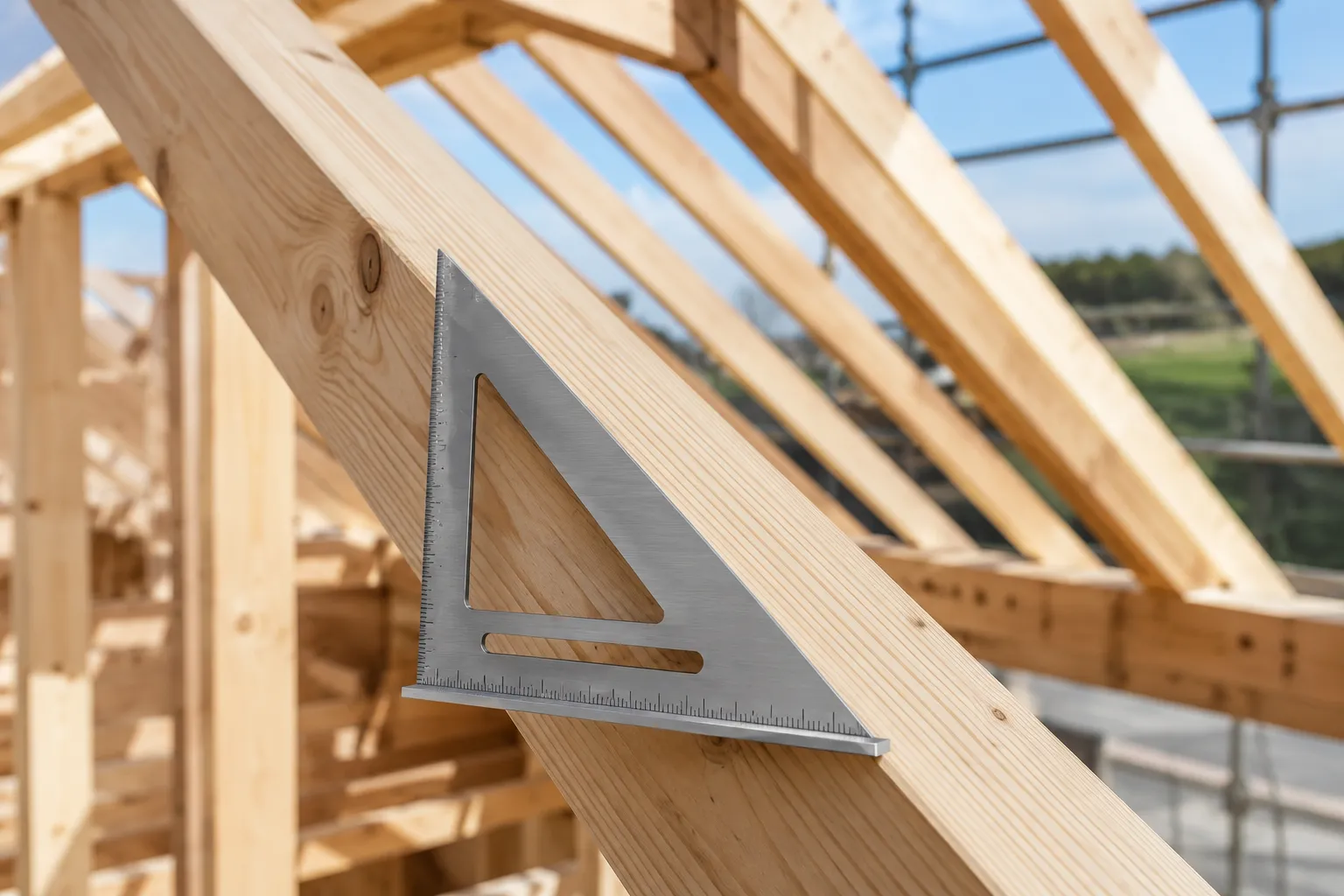
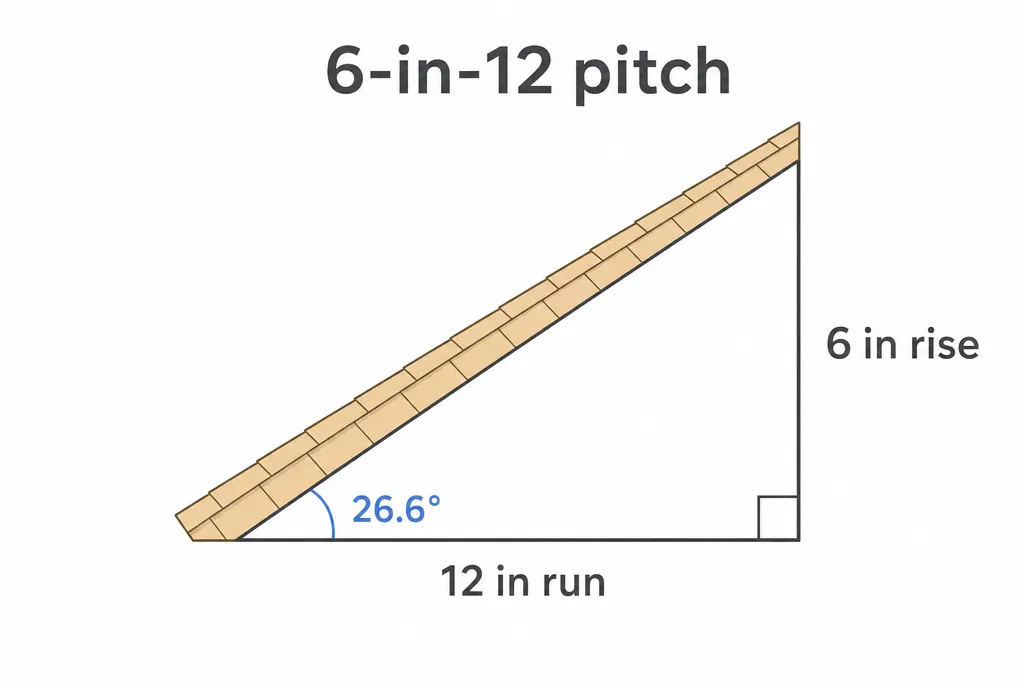
How roof pitch is written and measured
Roofers describe slope as a ratio of rise over run — almost always over a run of 12. A “6-in-12 pitch” means the roof climbs 6 inches vertically for every 12 inches it travels horizontally. The run is fixed at 12, so only the first number changes, which is why you hear a roof called simply “a six” or “an eight.”
That ratio converts cleanly into the other two ways of describing slope. The angle in degrees is arctan(rise ÷ 12), and the percent grade is (rise ÷ 12) × 100. Both describe the exact same steepness — they’re just different units, the same way you can state a temperature in Celsius or Fahrenheit. If you want the full background on why these three forms are interchangeable, see degrees, percent and ratio explained.
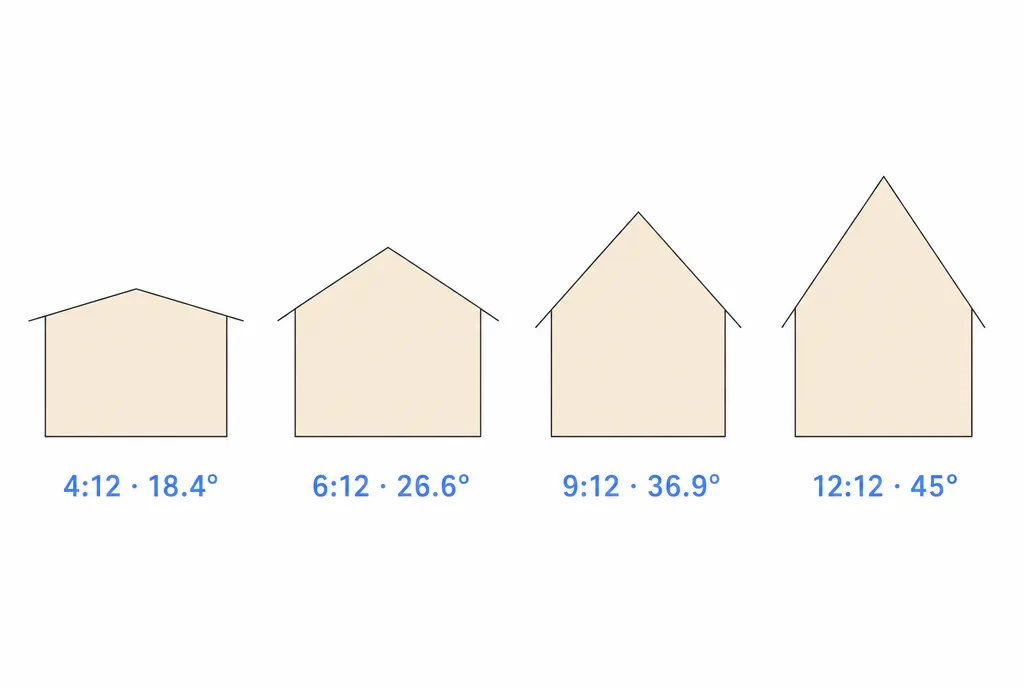
Common roof pitches chart
Here is a reference chart of the pitches you’ll meet most often, with each one’s angle and grade worked out from the formulas above. Note that percent grade hits a round number whenever the rise divides evenly into 12.
| Pitch (rise-in-12) | Angle (degrees) | Grade (percent) |
|---|---|---|
| 1-in-12 | ≈ 4.76° | ≈ 8.3% |
| 2-in-12 | ≈ 9.46° | ≈ 16.7% |
| 3-in-12 | ≈ 14.04° | 25% |
| 4-in-12 | ≈ 18.43° | ≈ 33.3% |
| 6-in-12 | ≈ 26.57° | 50% |
| 8-in-12 | ≈ 33.69° | ≈ 66.7% |
| 9-in-12 | ≈ 36.87° | 75% |
| 12-in-12 | 45° | 100% |
A useful anchor to memorize is the bottom row: a 12-in-12 roof rises exactly as much as it runs, so it sits at a perfect 45° and a 100% grade. Everything gentler than that falls below 45°. Notice too that 100% grade is not vertical — it just means rise equals run. A truly vertical wall would be an infinite grade, which is one reason percent can be a confusing unit for steep surfaces.
Flat and low-slope roofs (under 4-in-12)
Anything below 2-in-12 (under about 9.46° or 16.7%) is treated as flat or low-slope, even though almost no roof is dead level. These roofs shed water too slowly for shingles to keep up, so they’re covered with continuous membrane systems — EPDM, TPO or built-up rolls — and drainage becomes the main design concern. Standing water, not wind, is the enemy here.
From 2-in-12 to 4-in-12 you’re in low-slope territory: roughly 9.5° to 18.4°, or about 16.7% to 33.3% grade. This is the gentlest range where asphalt shingles are allowed, usually only with extra underlayment. Low slopes are common on porches, additions and ranch-style homes, and they’re walkable enough that a person can stand on them comfortably during work.
Conventional and steep roofs (4-in-12 and up)
The conventional range — about 4-in-12 to 9-in-12 — covers most shingled houses you’ll see. That’s roughly 18.4° to 36.9°, or 33.3% to 75% grade. A 6-in-12 roof (26.57°, 50%) sits right in the middle and is one of the most common residential pitches: steep enough to shed rain and snow well, shallow enough that roofers can still work on it without staging or harnesses.
Past 9-in-12 you reach steep-slope roofs — over 36.87°, climbing toward the 45° of a 12-in-12. Steep pitches shed snow and water aggressively, give a house a dramatic, traditional silhouette, and create usable attic volume underneath. The trade-off is labor: anything above roughly an 8-in-12 is hard to walk, so it generally needs scaffolding, roof jacks or fall protection, which raises the cost of every job on it.
How to measure your own roof’s pitch
You don’t have to guess which row of the chart your roof lands on. The most direct method is to set a level horizontally against a rafter or the roof surface, measure 12 inches along it, and measure straight down from the level’s 12-inch mark to the roof — that vertical distance, in inches, is your rise-in-12.
If you’d rather not climb up, you can read the pitch from a photo or sight it from the yard; we walk through that in how to measure roof pitch from the ground. And once you have any one value — ratio, angle or grade — you can convert it to the other two instantly with our roof pitch calculator, so you never have to reach for arctangent by hand. However you capture it, the chart above tells you what that pitch means and where it’s typically used.
Frequently asked questions

Angle Measuring Tools Compared: Which One Do You Need?
What each angle measuring tool does best — protractor, T-bevel, speed square, digital angle gauge, phone app, online protractor — and how to pick one.
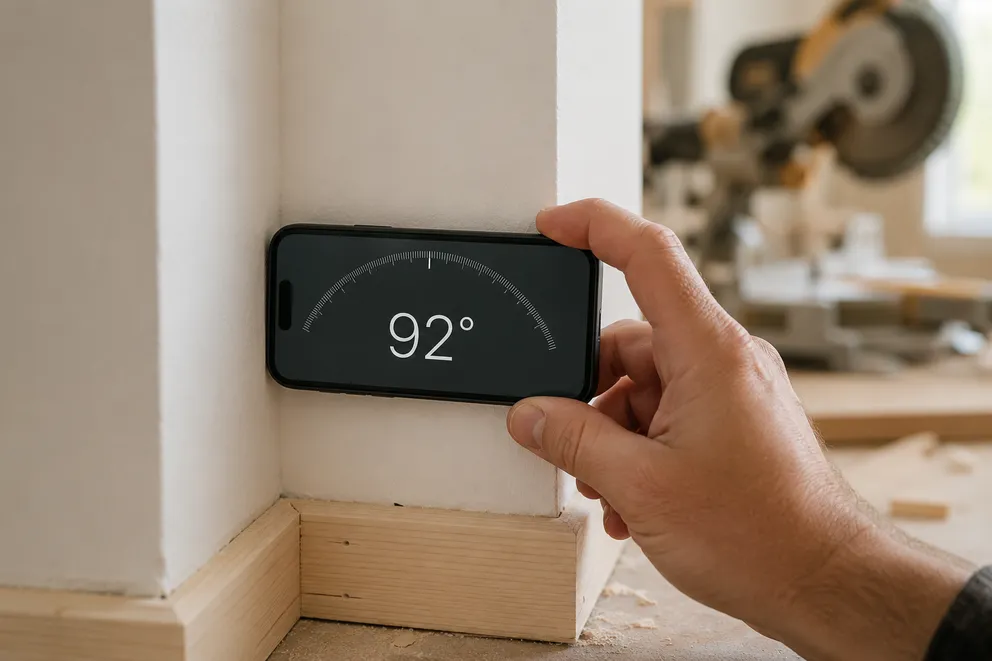
How to Measure the Angle Between Two Walls
Three ways to measure the true angle between two walls — phone with zeroing, T-bevel and protractor, or camera mode — and turn it into the right miter cut.
Measure any angle,
right from your pocket.
Protractor turns your phone into a precision angle finder, level and inclinometer. Measure anything, anywhere.
Download the App