
How to Measure (and Mark) a 30-Degree Angle
What a 30-degree angle is
Thirty degrees is one third of a right angle and half of 60° — the sharp end of the classic 30-60-90 triangle that shows up as the slim drafting set square in every geometry kit. For scale, it’s the angle between clock hands at exactly 1 o’clock, and it’s noticeably tighter than a 45° angle, the diagonal of a square.
It earns its keep in the shop: 30° miters build hexagonal frames (six sides at 30° each side of the joint), 30° bevels show up in roof framing and chamfers, and 30/60 pairs let you divide circles into twelve. Four ways to get one, from most common to most clever.
1. With a protractor
Lay down a baseline and pick the vertex point. Set the protractor’s origin on the vertex, align 0° with the baseline, then count up the scale that starts at your baseline until you reach 30 — a protractor carries two opposing scales, and the wrong one hands you 150° instead. Dot the mark, remove the tool, and join vertex to dot with a straightedge.
The one habit that prevents nearly every protractor mistake: before you mark, ask whether the angle you’re about to draw looks the way it should. Thirty degrees is a sharp sliver; if your dot would produce a wide, lazy opening, you’re on the wrong scale. The fundamentals are covered in how to use a protractor, and the online protractor lets you rehearse the two-scale readout before touching paper.
2. With a speed square’s degree scale
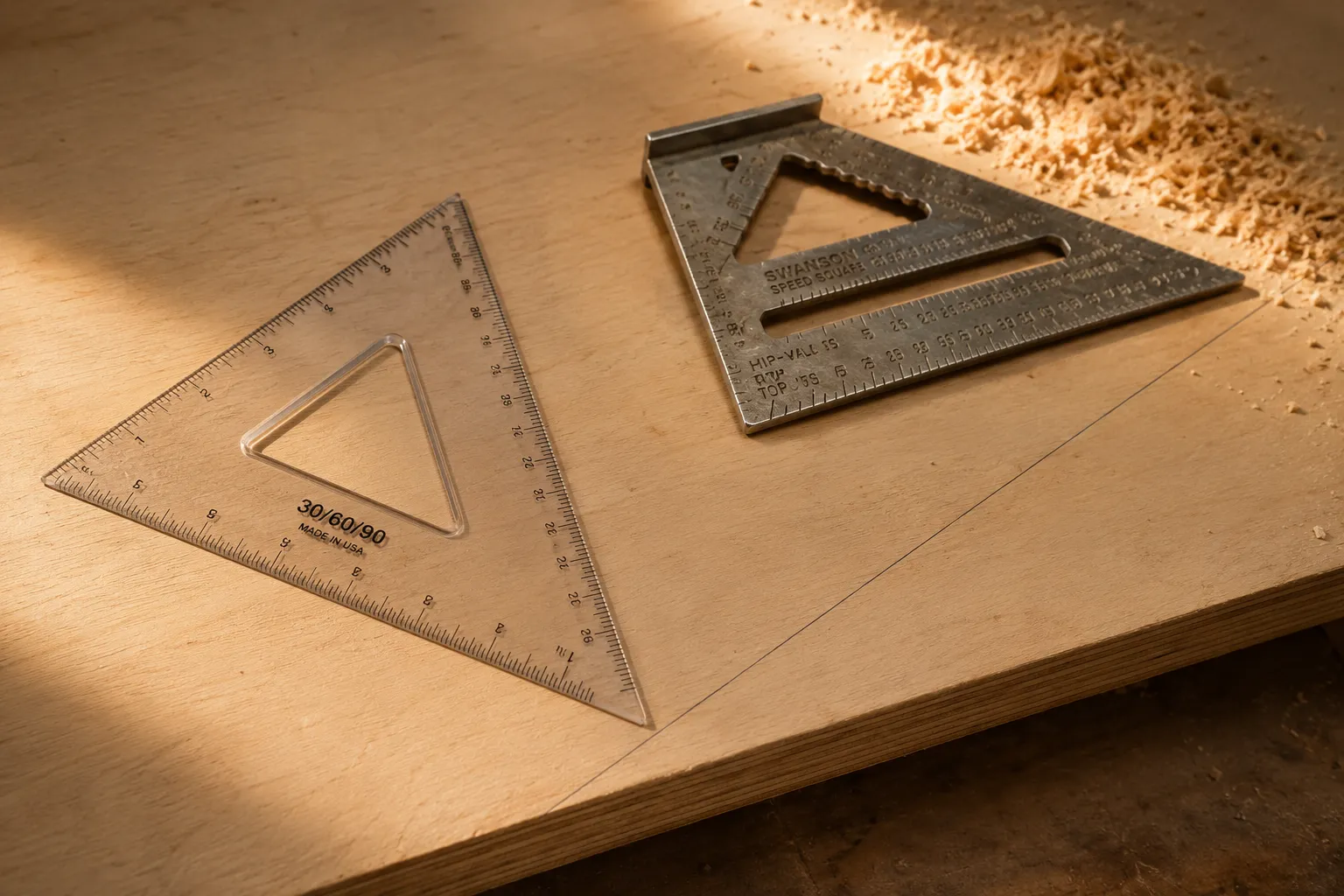
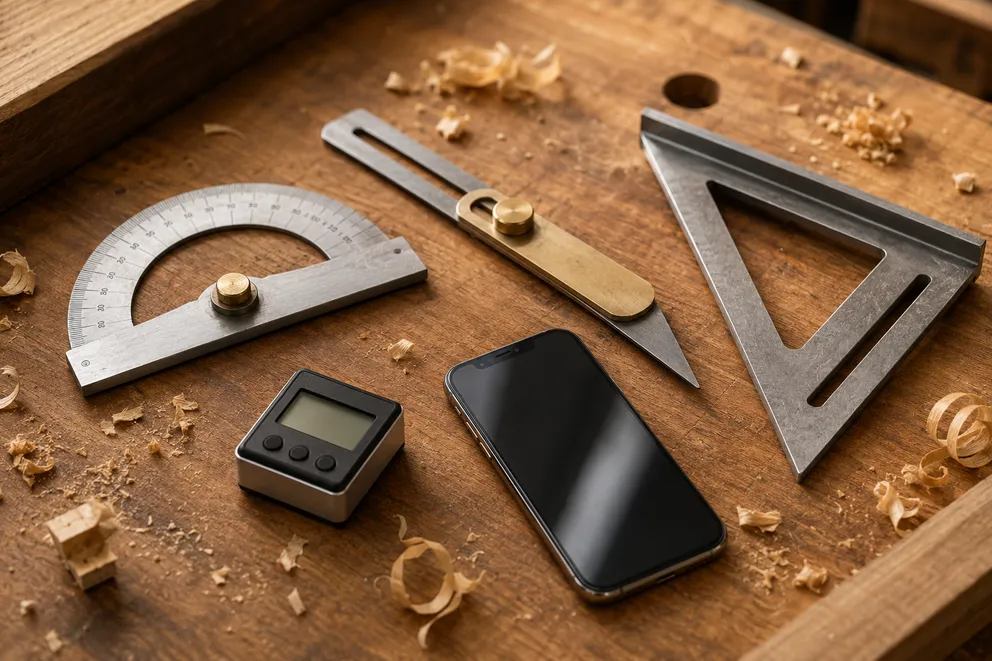
A speed square does more than 90° and 45° — its long edge carries a degree scale from 0 to 90. Hook the square’s lip over the edge of the board, hold the pivot corner tight, and swing the square until the board’s edge lines up with the 30 mark on the scale. Scribe along the ruled edge and you have a 30° line off the board’s edge. It’s the go-to method on a job site, where a drafting triangle would never survive the truck.
3. With a 30-60-90 drafting triangle
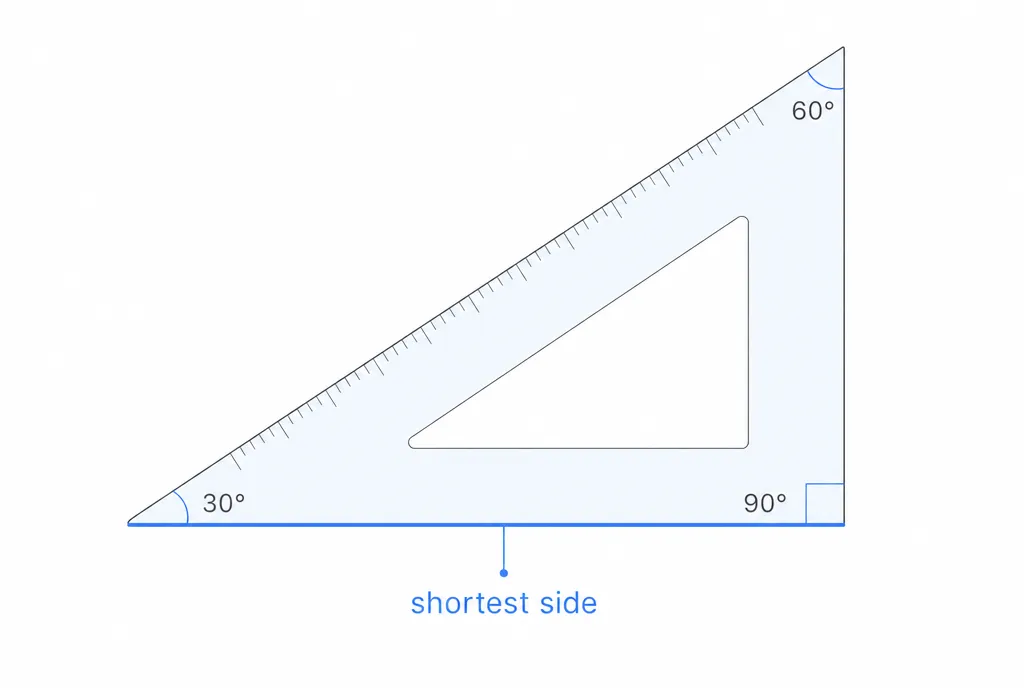
The slim set square from a geometry set is a 30° template. Lay its longest leg along your baseline with the sharp tip at the vertex, and trace the hypotenuse — that traced line meets the baseline at exactly 30°. Flip the triangle over to mark the mirror image, or stand it on its short leg to get 60° instead. For layout on paper, plans, or sheet goods, nothing is faster or more repeatable.
4. The geometry trick: a 2:1 hypotenuse
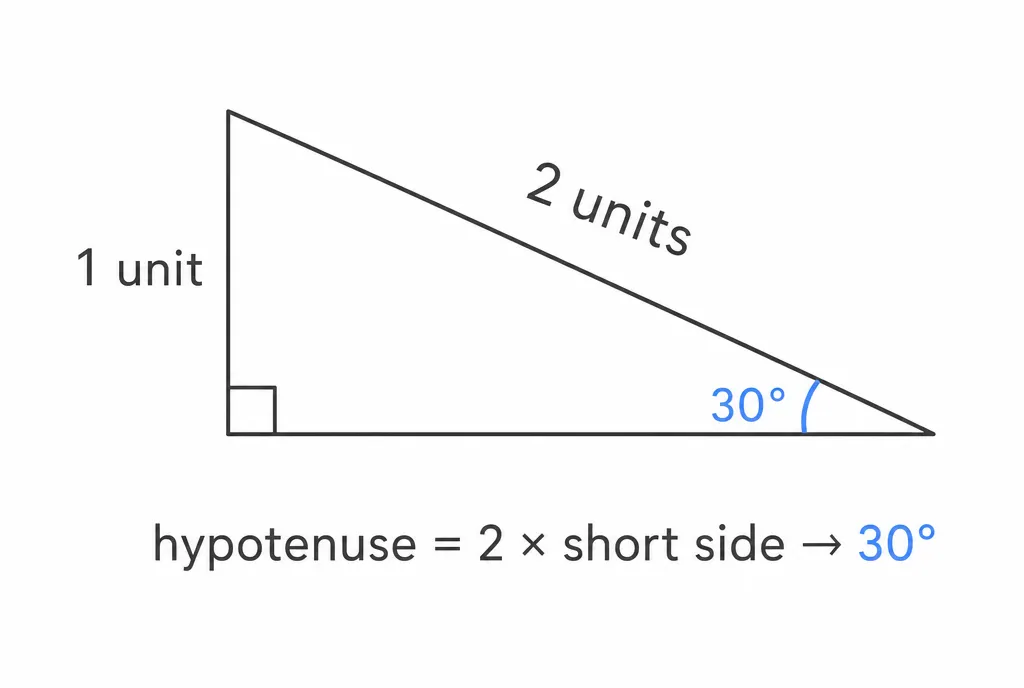
A 30-60-90 triangle has one famous property: the side opposite the 30° corner is exactly half the hypotenuse. Reverse that fact and you can construct 30° with just a ruler:
- Draw a baseline and mark your vertex, point A.
- Somewhere down the line, at point B, draw a line square to the baseline (trace a corner of anything truly 90°). Make it a convenient height — say 6 inches — and call the top point C.
- Now position A so the diagonal works out, or simpler: from C, swing an arc of 12 inches (twice the height) down to the baseline. Where it lands is your vertex A.
- Draw the line from A through C. Because AC = 12” and the rise BC = 6” — a perfect 2:1 — the angle at A is exactly 30°.
Any pair of numbers works as long as the hypotenuse is double the rise: 4” and 8”, 250 mm and 500 mm. The longer the layout, the more a small pencil-width error gets diluted, so go big when accuracy matters.
Checking it with your phone
Marking is half the job; the cut is the other half. To verify a 30° bevel or miter, stand the workpiece so the reference face is plumb or flat, rest an iPhone on the cut surface, and read the tilt — 30.0° means the cut matches the mark. It’s especially useful for saw setups, since some miter-saw scales measure from square rather than from the fence, and the phone reads the actual angle of the finished face, not the dial. Cut a scrap first, measure it, adjust by the difference, and your real stock gets the true 30°.
Frequently asked questions
How to Hang Pictures Perfectly Level (Every Time)
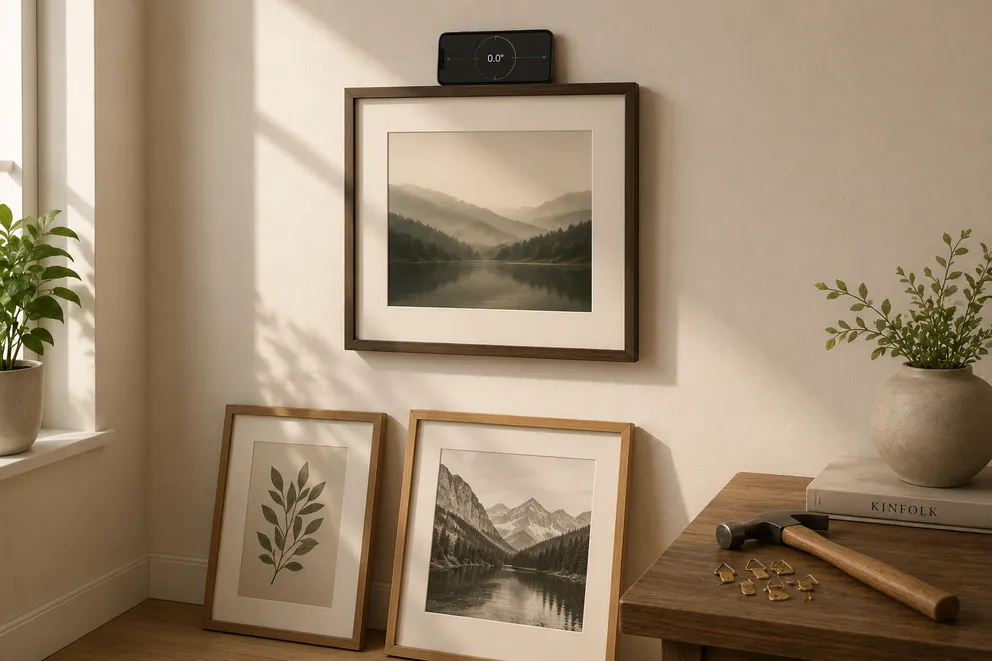
Why frames end up crooked, how to level them with the phone-on-the-frame trick, hanging with two hooks, and keeping a gallery wall straight for good.
Angle Measuring Tools Compared: Which One Do You Need?
What each angle measuring tool does best — protractor, T-bevel, speed square, digital angle gauge, phone app, online protractor — and how to pick one.
Measure any angle,
right from your pocket.
Protractor turns your phone into a precision angle finder, level and inclinometer. Measure anything, anywhere.
Download the App