
Degrees, Percent Slope, and Ratio: How to Convert
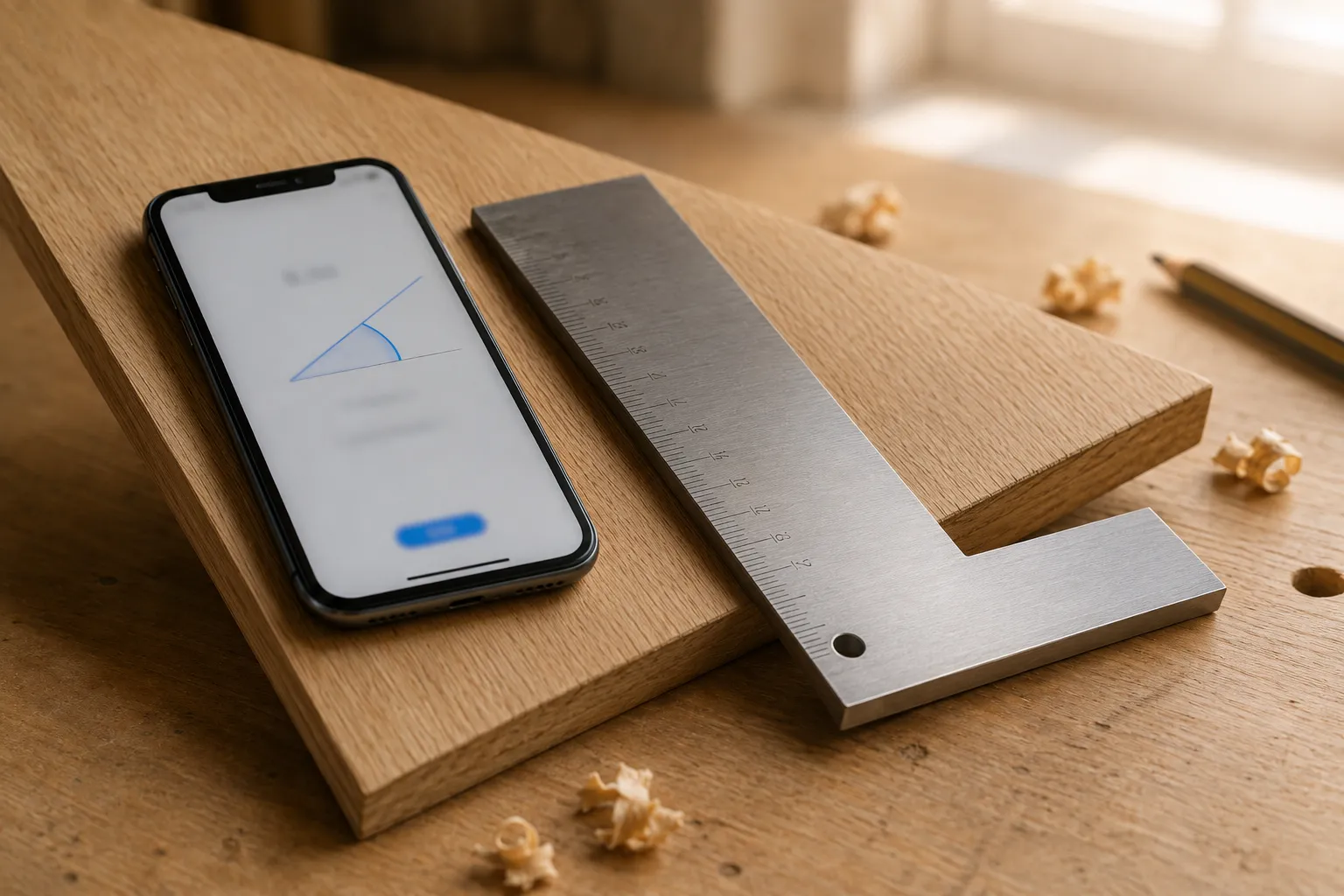
One slope, three names
A slope is just how steeply a surface tilts away from flat. There’s nothing complicated underneath it: pick a horizontal distance, see how far the surface rises over that distance, and you’ve described the steepness. The confusion comes from the fact that three different fields settled on three different ways to write down that same number.
Degrees measure the angle directly, from 0° (perfectly flat) to 90° (vertical). It’s the unit you learned in geometry and the one a protractor reads off paper.
Percent grade describes the slope as rise divided by run, times 100. Walk 100 feet forward and climb 6 feet, and you’re on a 6% grade.
Ratio — usually written X-in-12 in roofing — gives the rise for a fixed run of 12. A roof that goes up 6 units for every 12 across is a 6-in-12 pitch.
All three point at the exact same tilt. They just answer the question with a different yardstick.
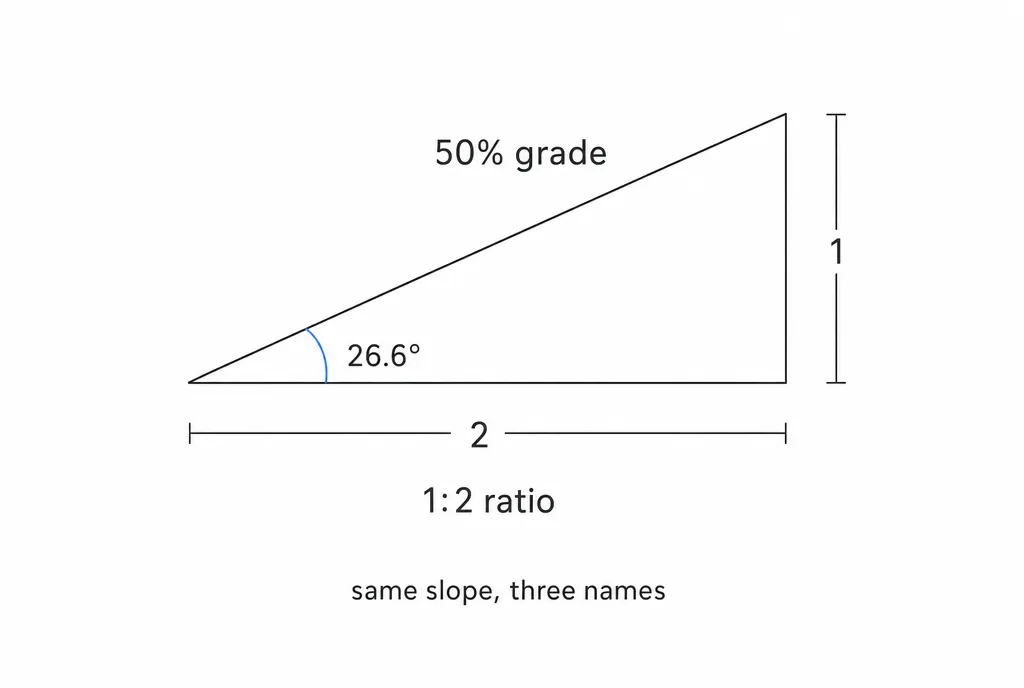
Degrees and percent grade
The link between an angle and a percent grade is the tangent function. Percent grade is rise over run, and the tangent of an angle is also rise over run — so they’re the same quantity, scaled by 100:
percent grade = tan(angle) × 100
A few anchor values make this concrete:
- At 45°, the rise equals the run, so tan(45°) = 1 and the grade is 100%.
- At 26.57°, the rise is half the run, so tan ≈ 0.5 and the grade is 50%.
- At 10°, tan ≈ 0.176, so the grade is about 17.6% — not 10%.
That last one trips people up constantly. A 10° slope is not a 10% grade. They only line up near zero, where the curve is nearly straight; the higher the angle climbs, the faster percent pulls ahead. By 45° they’ve split all the way to 100%, and as the angle approaches vertical the percent runs off toward infinity.
To go the other direction, undo the tangent with its inverse, the arctangent:
angle = arctan(percent ÷ 100)
So a 30% grade is arctan(0.30) ≈ 16.7°, and a 100% grade is arctan(1) = 45°. Any scientific calculator has the tan and arctan (often tan⁻¹) keys you need for both directions.
Ratio: the roofer’s shortcut
Roofing pitch is written as a ratio because of how a carpenter works. A framing square has a 12-inch arm, so 12 becomes the natural run to measure against. A 6-in-12 pitch means the roof climbs 6 inches for every 12 inches of horizontal travel — and the carpenter can lay that out directly on lumber without touching trigonometry.
To find the angle, it’s the same tangent relationship with 12 as the run:
pitch angle = arctan(rise ÷ 12)
A 6-in-12 pitch is arctan(6 ÷ 12) = arctan(0.5) ≈ 26.57° — which, you’ll notice, is the same 50% grade from the section above. A 12-in-12 pitch is arctan(1) = 45° = 100%. The three systems converge on identical slopes; only the notation changes.
A reference table of common slopes
Here are the values you’ll meet most often, lined up so you can read across between systems:
| Ratio | Degrees | Percent grade |
|---|---|---|
| 4-in-12 | ≈ 18.43° | ≈ 33.3% |
| 6-in-12 | ≈ 26.57° | 50% |
| 8-in-12 | ≈ 33.69° | ≈ 66.7% |
| 12-in-12 | 45° | 100% |
Reading the table is itself a conversion lesson. A 12-in-12 roof — rise equal to run — is exactly 45° and exactly 100%, the cleanest landmark in the whole system. A 6-in-12 is half that rise per unit of run, landing at 50%. And notice the percent column is not proportional to the degrees column: doubling the ratio from 6-in-12 to 12-in-12 doubles the percent, but the angle goes from 26.57° to 45°, not to 53°. That’s the tangent curve at work.
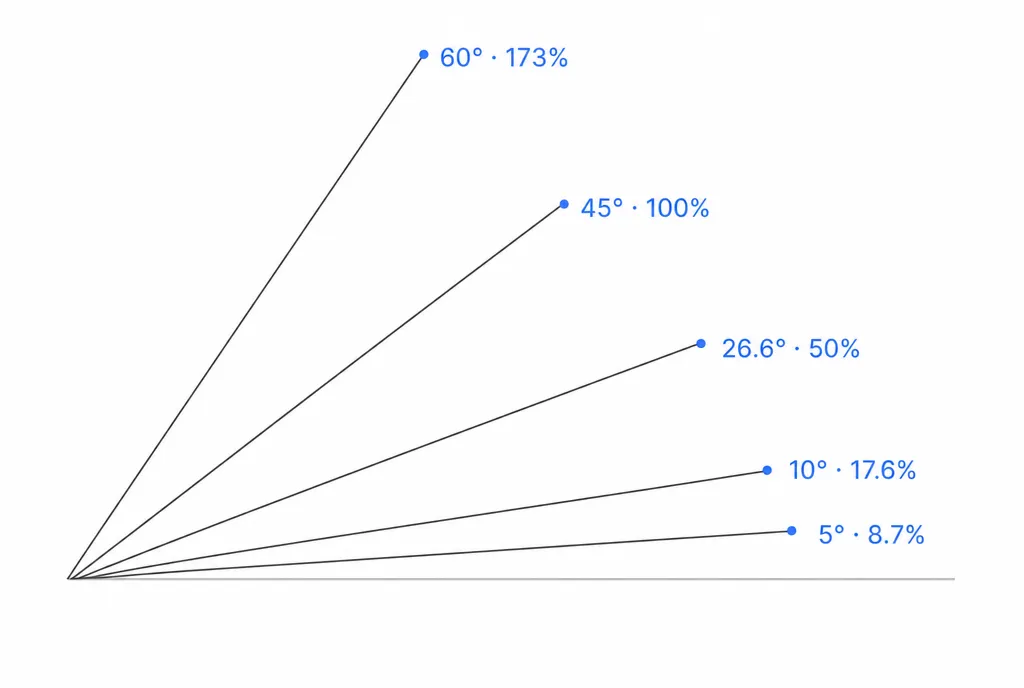
Which field uses which
Each unit stuck where it did for a practical reason, and knowing the convention saves you from quoting the wrong one:
- Roofers and carpenters use ratio. X-in-12 maps straight onto a framing square, so it sets rafter cuts without any math.
- Civil engineers and road signs use percent. A “7% grade” sign tells a trucker how hard the descent is per unit of distance, which is exactly what matters for braking.
- Math, machining, and drafting use degrees. Angles compose cleanly, and every protractor and CAD tool speaks them.
- Trail and accessibility specs mix percent and ratio. An ADA ramp, for instance, is capped at a 1-in-12 ratio, which is about 8.3% or 4.76°.
The tradeoff is that whoever you’re talking to may want a different unit than the one you measured in. That’s where measuring on a phone helps: rest the device on the surface, read the slope from its motion sensors, and switch the readout between degrees, percent, and ratio without doing any arithmetic. For roofs specifically, a dedicated roof pitch calculator takes a rise and run and hands back all three at once.
The takeaway is simple: degrees, percent, and ratio are three dialects for one idea. Learn the tangent that links them and you can move between any two — or let a tool do it the instant you take the reading.
Frequently asked questions

Angle Measuring Tools Compared: Which One Do You Need?
What each angle measuring tool does best — protractor, T-bevel, speed square, digital angle gauge, phone app, online protractor — and how to pick one.
How to Measure the Angle Between Two Walls
Three ways to measure the true angle between two walls — phone with zeroing, T-bevel and protractor, or camera mode — and turn it into the right miter cut.
Measure any angle,
right from your pocket.
Protractor turns your phone into a precision angle finder, level and inclinometer. Measure anything, anywhere.
Download the App