
How to Measure the Angle Between Two Walls
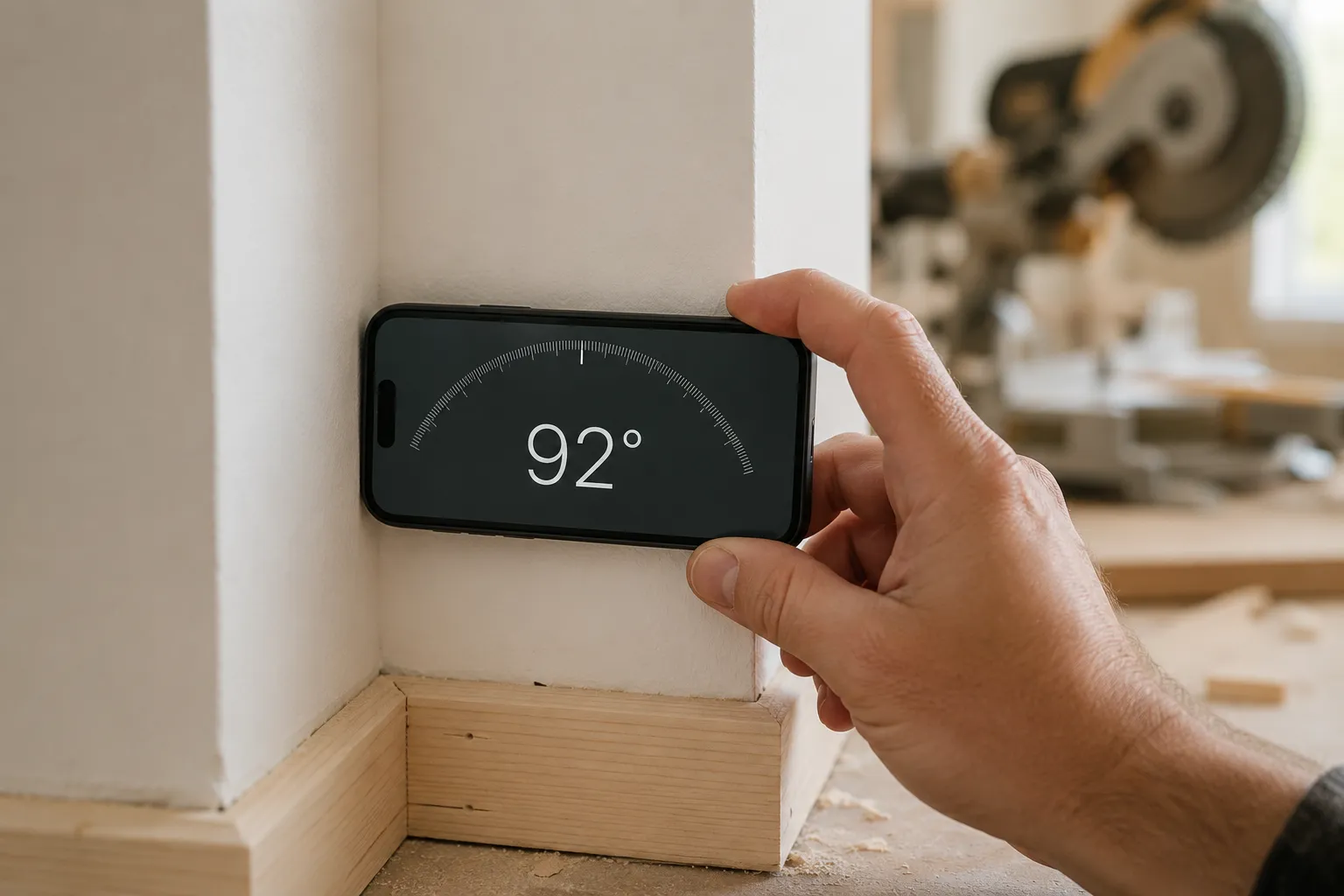
Why corners are almost never 90°
Framing lumber twists, drywall builds up unevenly at corners, and taping compound adds its own bump — so a “square” corner in a finished room commonly runs anywhere from 88° to 92°. Cut trim at a blind 45° for a corner that’s actually 92° and you’ll get a 1° gap on each side of the joint, which caulk can’t fully hide.
The fix is to measure the corner you actually have, not the one on the plans. Three methods, from fastest to most traditional.
Method 1: phone with zeroing
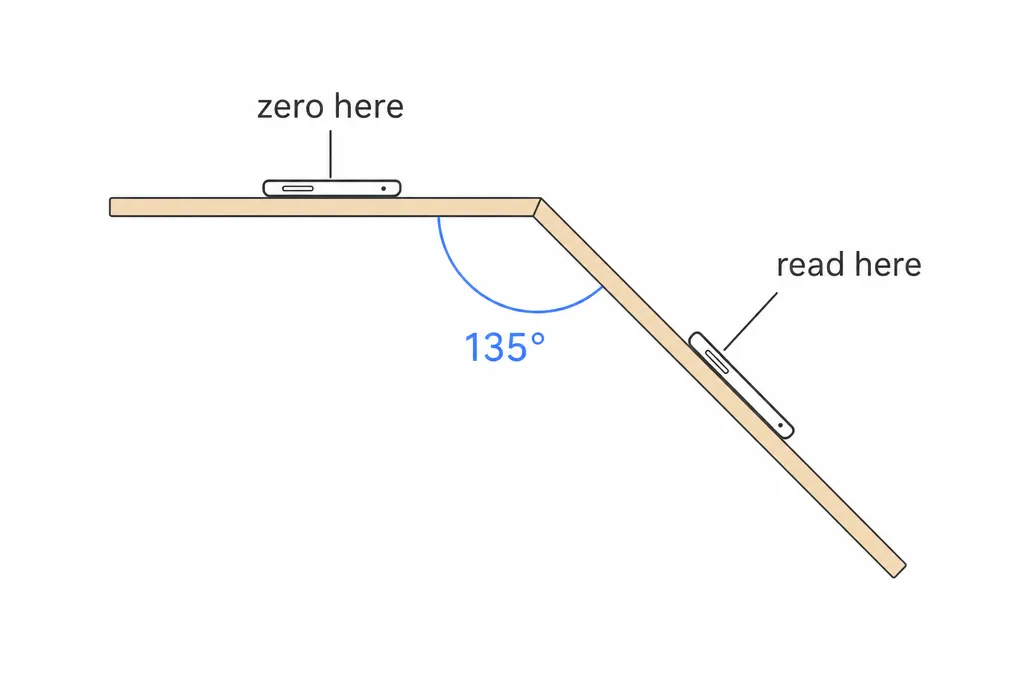
The quickest way to get a number on a corner is the two-surface technique with your phone as a digital angle finder:
- Hold the phone flat against one wall face, on edge, a few inches from the corner. Pick a spot clear of outlet covers and drywall bumps.
- Zero the reading. This makes the first wall your reference, so any lean in the wall itself drops out.
- Move the phone to the other wall face, same height, and hold it flat.
- Read the angle. That’s the true angle between the two walls — 91.5°, 88°, whatever it really is.
One note on geometry: this works on vertical wall faces, where rotating the phone from one wall to the other sweeps through the corner angle. It’s the same zero-and-move workflow covered in detail in how to use an angle finder. Take the measurement at trim height — a corner can read differently at the floor than at eye level, and the number that matters is where the molding will sit.
Method 2: sliding T-bevel and protractor
The traditional answer, and still the most foolproof for weird corners:
- Press the T-bevel’s handle against one wall and swing the blade flat against the other, seated fully into (or around) the corner.
- Lock the wing nut. The tool now holds the exact corner angle.
- Read it with a protractor — or skip the number entirely and set your saw directly from the locked bevel.
The T-bevel’s superpower is that it doesn’t care what the angle is called; it just carries the corner to the saw. Its weakness is baseboard-height corners packed with flooring or shims, where the blade can’t seat cleanly.
Method 3: camera mode from above
For a corner you can see but can’t easily press tools into — behind a radiator, a fenced stair angle, a countertop notch — measure it from a plan view. Hold the phone directly over the corner, looking straight down so both wall lines are visible, and read the angle between the two lines off the image in camera mode. You can also scribe a line along each wall onto masking tape on the floor, pull the tape, and measure the drawn angle at the desk.
Camera measurements are honest to a degree or so; for paint-grade trim that’s fine, and for stain-grade you can confirm with a test cut.
Turning a corner angle into a miter angle
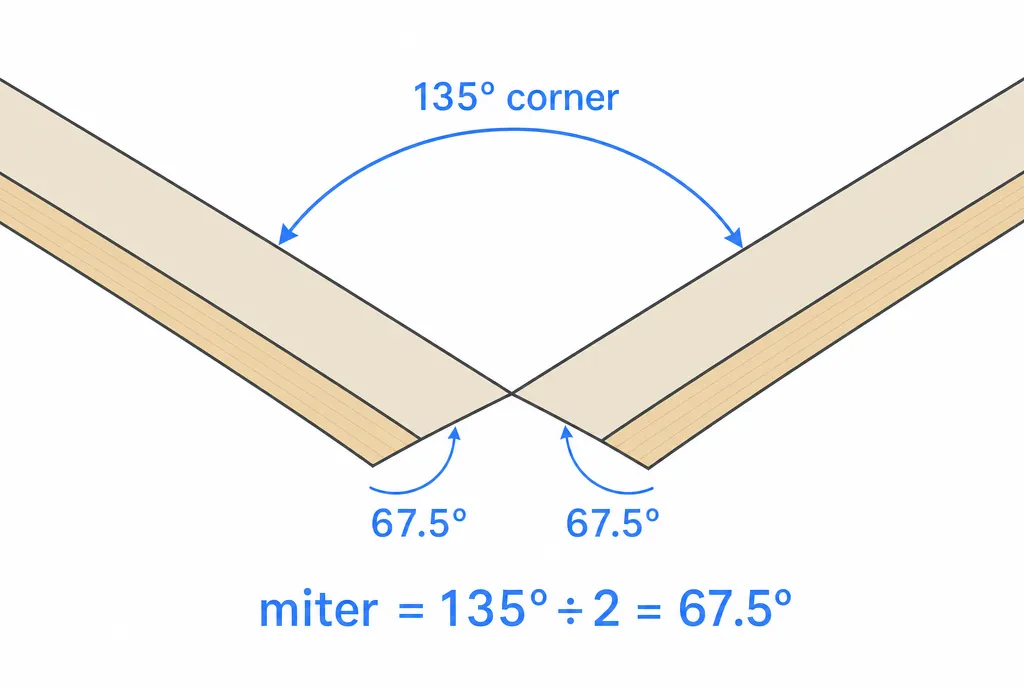
The rule is one line long: miter = corner ÷ 2. Each of the two trim pieces gets half the corner, so the joint closes exactly on the corner line.
- 90° corner → two 45° miters
- 92° corner → two 46° miters
- 88° corner → two 44° miters
- 135° corner (a bay window wall) → two 67.5° miters
Cut both pieces at the same half-angle even if one wall looks “more off” than the other — splitting the difference is what makes the joint symmetrical. Saw setup, coping as an alternative for inside corners, and dialing out the last half-degree are all covered in how to cut miter angles.
Inside vs. outside corners
An inside corner and an outside corner at the same wall junction are supplements: if the inside reads 92°, the outside of that same junction wraps 268° of wall, but you still cut its trim from the exterior angle — 360° − 268° = 92° again, split into two 46° miters. In practice: measure the corner the trim actually wraps, divide by two, and cut. Outside corners are less forgiving because both cut edges show, so measure them first, cut a hair long, and sneak up on the fit.
Measure the corner, halve it, cut both pieces the same — that’s the entire trick, and it works on every corner in the house.
Frequently asked questions
Angle Measuring Tools Compared: Which One Do You Need?
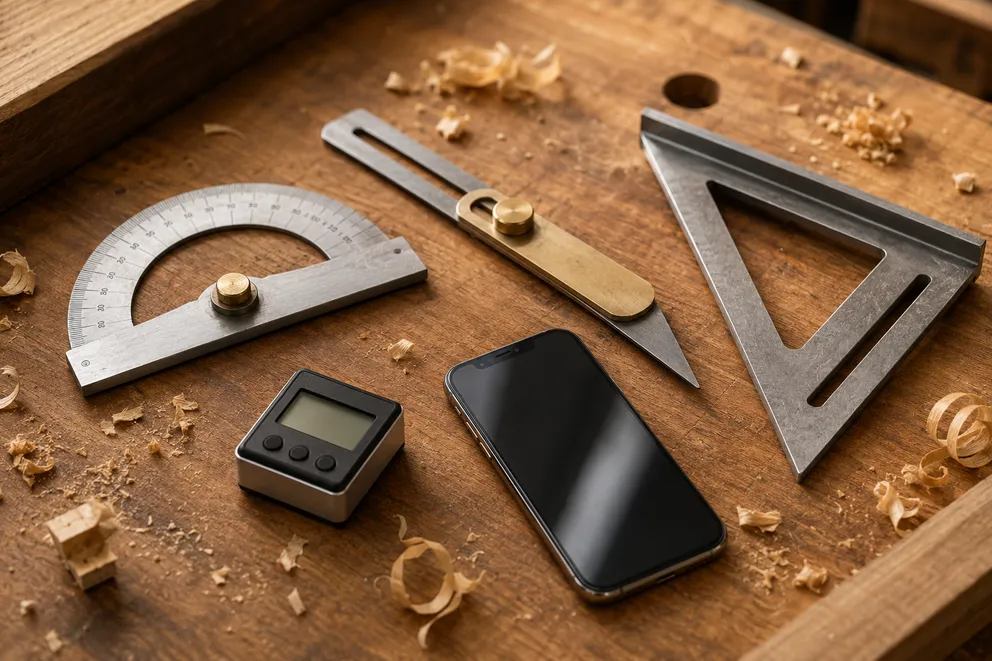
What each angle measuring tool does best — protractor, T-bevel, speed square, digital angle gauge, phone app, online protractor — and how to pick one.
How to Measure a Ramp's Slope (and Check the ADA 1:12 Rule)
How to measure a ramp's slope with your phone and check it against the ADA 1:12 maximum — plus percent and degree conversions, cross-slope, and landings.
Measure any angle,
right from your pocket.
Protractor turns your phone into a precision angle finder, level and inclinometer. Measure anything, anywhere.
Download the App