The standard: 2%, away from the house
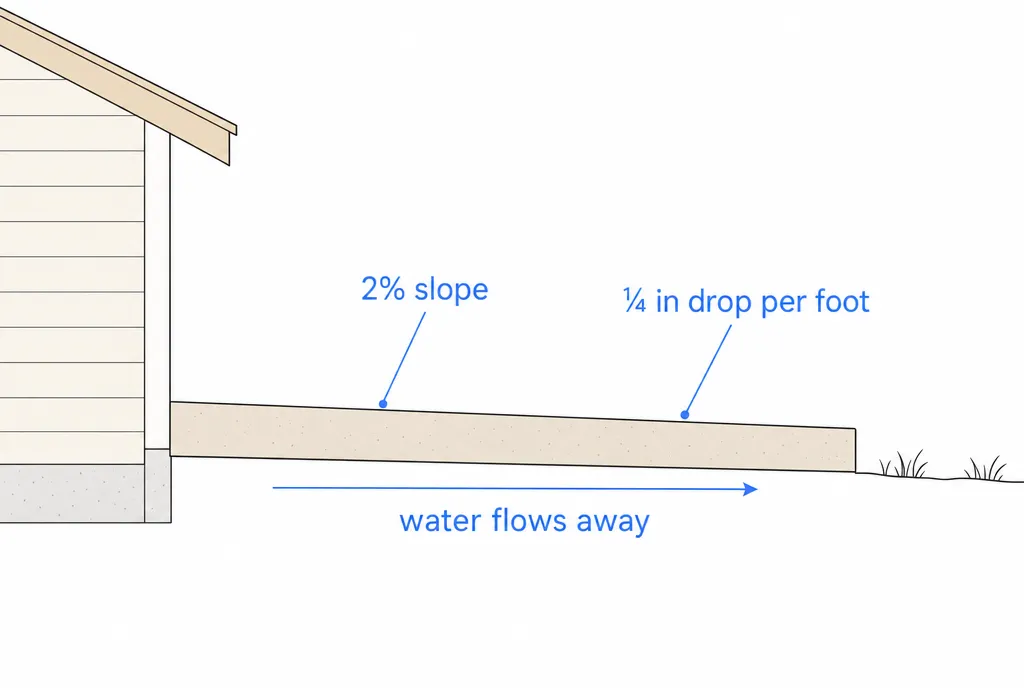
For concrete patios, pavers, walkways, and most other hardscape, the widely used drainage standard is a 2% slope — 1/4 inch of drop per foot of run. A 12-foot patio should sit about 3 inches lower at its outer edge than at the house.
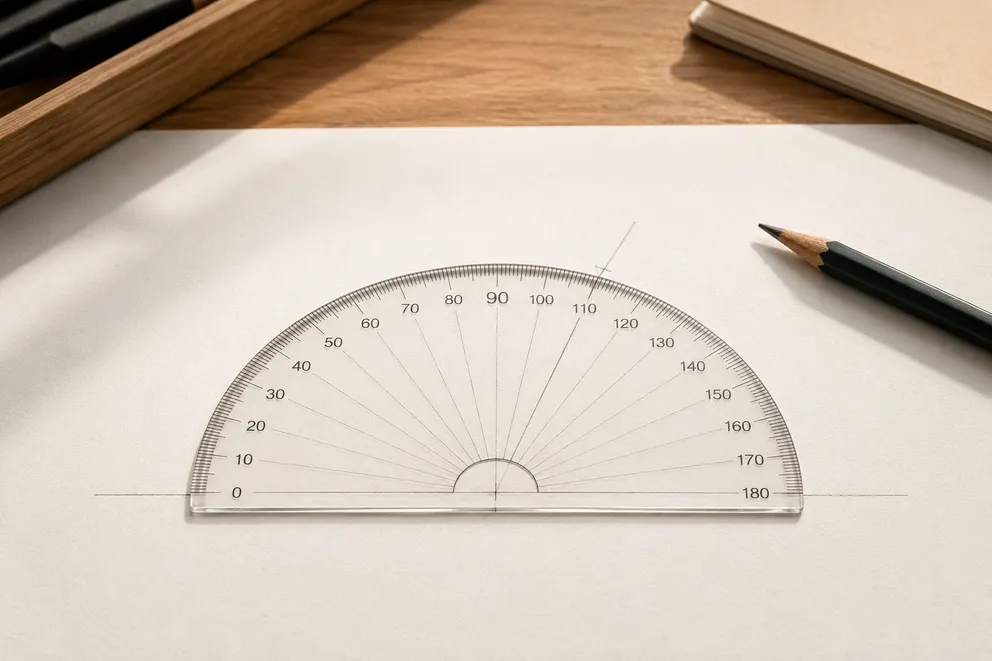
In degrees, 2% is about 1.15° — shallow enough that the surface looks and feels flat, steep enough that rainwater sheds instead of pooling. That’s the point of the number: it’s the practical minimum for reliable drainage, not a target to overshoot. Go much flatter and water sits in every low spot; go much steeper and furniture starts to lean and the slope becomes visible.
You’ll see the same figure written three ways — 2%, 1/4 in per foot, ~1.15° — and they’re all one slope. If juggling the units trips you up, the conversions are laid out in degrees, percent slope, and ratio.
Decks are different — sometimes
Decks get a more honest answer than a single number.
Gapped decking can be built level. Standard wood or composite deck boards are installed with a gap of an eighth inch or more between them, and water simply falls through. Many builders frame these decks dead level, and that’s legitimate — there’s no surface for water to stand on.
Solid surfaces need pitch. Tongue-and-groove porch flooring, waterproof membranes over living space, tiled decks, or any surface that traps water should slope 1/8 to 1/4 inch per foot away from the house, and some builders give gapped composite a slight pitch anyway so the board surfaces themselves shed water and dry faster.
So the question isn’t “do decks need slope” — it’s “can water get through your deck surface.” If yes, level is fine. If no, treat it like a patio.
Direction matters more than the number
A patio with a perfect 2% slope toward the house is worse than a flat one. Every storm delivers water directly to the foundation, where it saturates the soil, works into basement walls, and in cold climates freezes against the concrete. Foundation repairs cost more than any patio.
The rule has no exceptions: the high side goes against the house, and the slope carries water toward the yard, a swale, or a drain. On a patio wrapped by walls on two sides, slope diagonally away from both, or pitch toward a channel drain that leads out.
Measuring the slope you already have
You don’t need surveying gear to check an existing patio — a straight board and a phone do it.
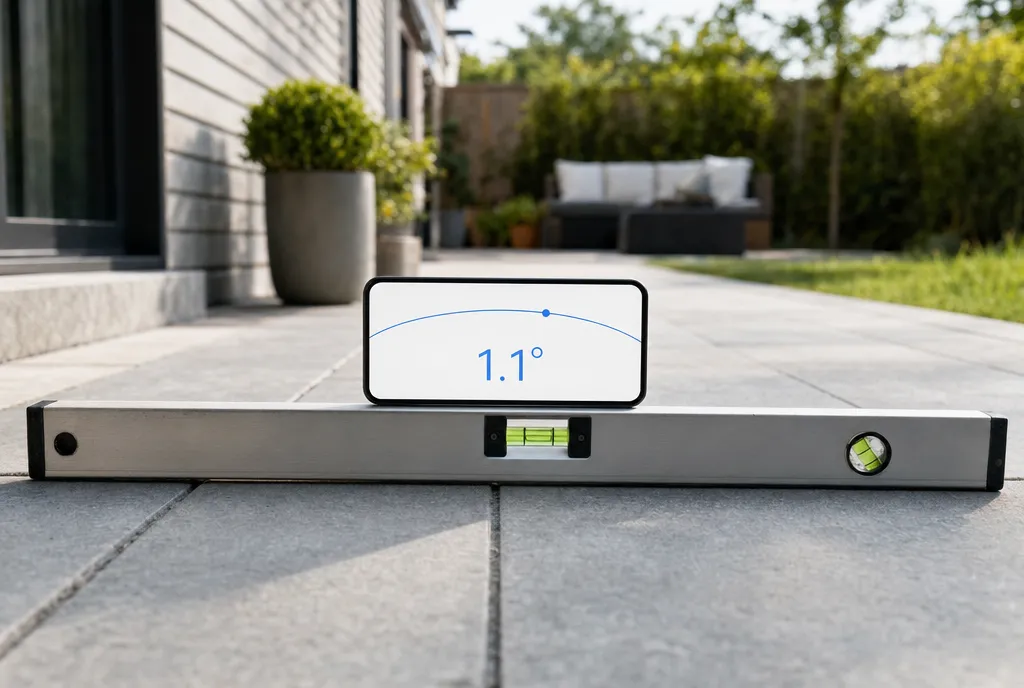
- Lay a straightedge on the surface — a 4- to 8-foot level, a straight 2×4 on edge — pointing directly away from the house. Longer is better; it bridges surface bumps and reads the overall grade.
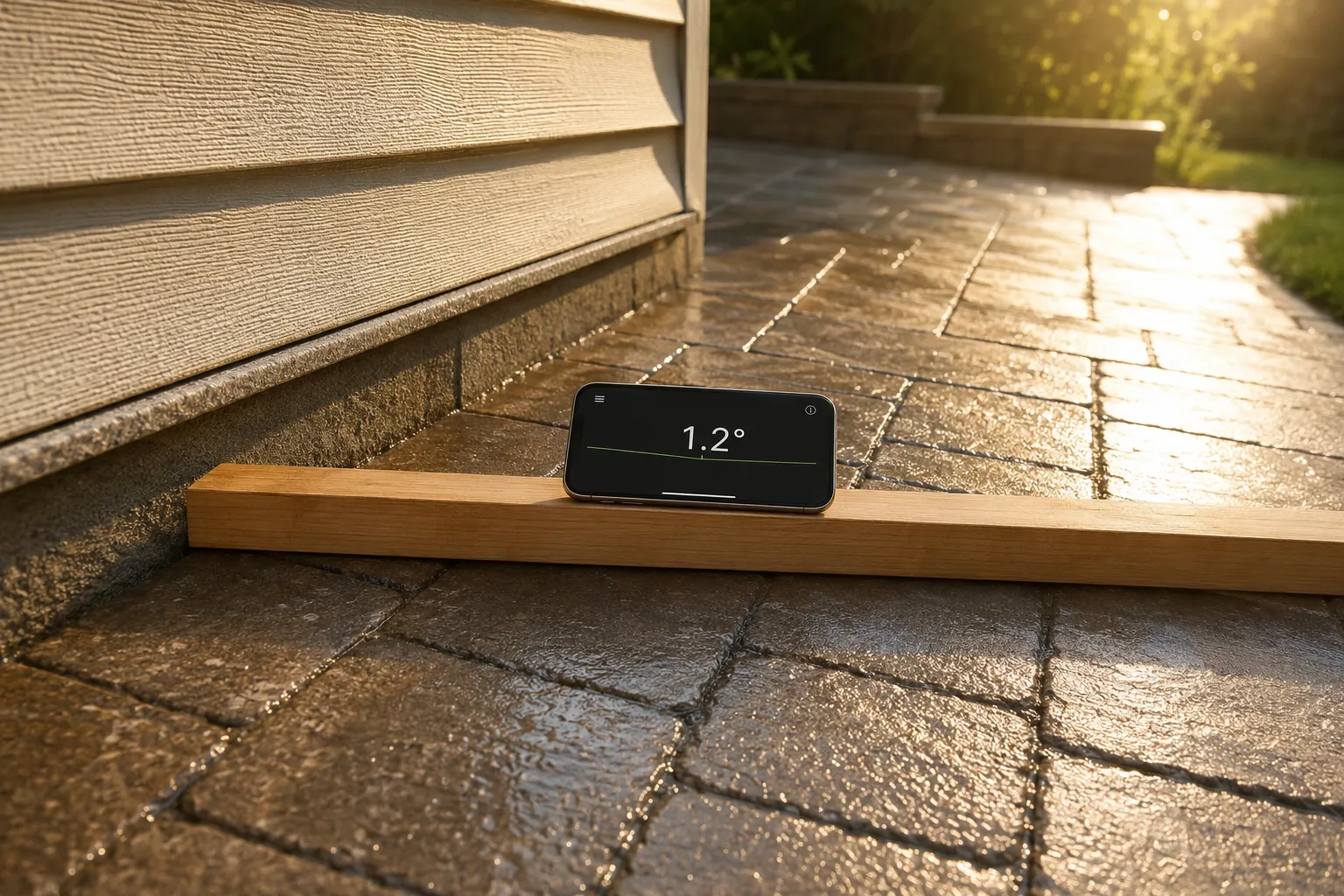
- Set the phone on top and read the angle. An inclinometer app shows the same reading in degrees, percent, or inches per foot, so there’s no conversion to do on the spot. You’re looking for roughly 1–1.5° (2%) downhill away from the house.
- Spot-check several lines. Measure near the house, at the outer edge, and along both sides. Slabs settle unevenly — a patio can be perfect on one line and back-pitched in a corner. The full technique, including calibrating the phone first, is in how to measure slope and incline.
A reading near zero, or worse, downhill toward the house, means the slab has settled and water is heading for your foundation.
Checking slope during construction
Building new? Verify the pitch before anything sets.
- String line and level: stretch a string from the house-side form to the outer form, level it, then measure down to the forms at each end. On a 12-foot run you want the outer form 3 inches lower.
- Phone on the screed board: as you screed concrete or level paver bedding, rest the phone on the screed board itself. It should read a steady 1.1–1.2° the whole pass — instant feedback, no strings.
- Check both directions: pitch away from the house along the run, level (or gently pitched) across it, so water doesn’t wander sideways into a corner.
Signs your slope is wrong
- Pooling that lasts more than a few hours after rain — the classic symptom of a flat or back-pitched spot.
- Water, staining, or moss at the foundation line — the slope is aimed the wrong way.
- A damp basement wall adjacent to the patio after storms.
- Ice sheets in winter where puddles used to be.
Any of these earns a five-minute check with a board and a phone. If the numbers confirm the problem, fixes range from slabjacking a settled slab to re-laying pavers on corrected bedding — but the measurement always comes first.