The idea behind every missing-angle problem
When a diagram shows some angles and asks for “the measure of angle x,” it’s really asking you to spot which total the angles belong to. Angles that share a line, a point, or a triangle always account for a fixed number of degrees, so once you know the total, the missing piece is simple subtraction. (If “measure” itself feels vague, what the measure of an angle means covers that single number and what it counts.)
Here are the five rules, each with a worked example.
Rule 1: Angles on a straight line sum to 180°
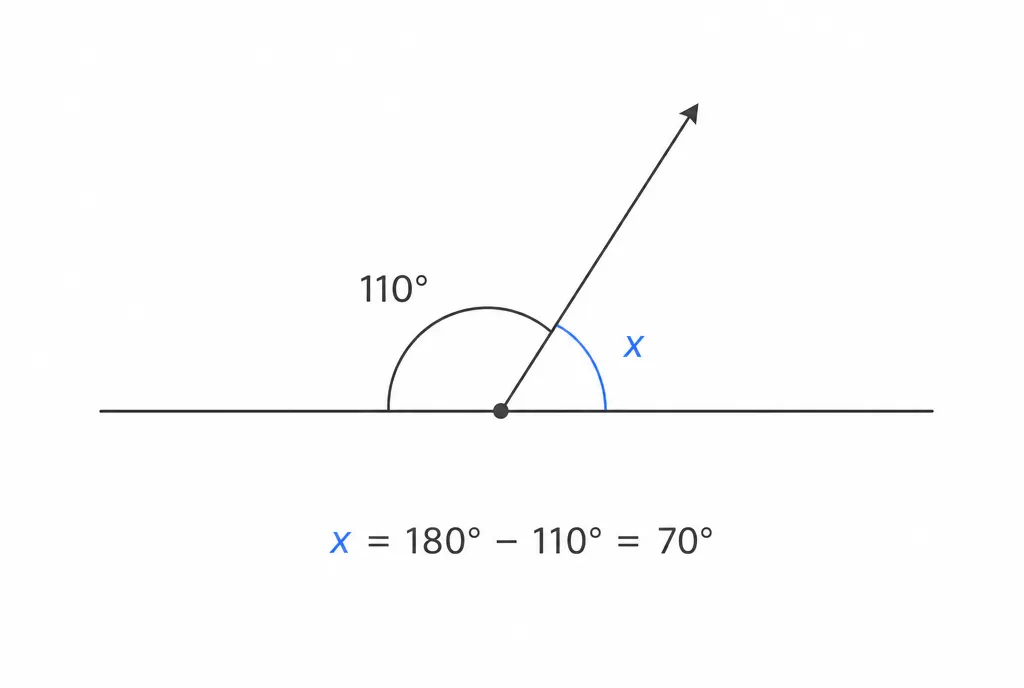
A straight line is a 180° angle, so any angles sitting together along one side of it must add up to 180°.
Example. Two angles share a straight line. One is 115°. The other is 180° − 115° = 65°. If three angles share the line — say 40° and 90° and x — then x = 180° − 40° − 90° = 50°.
Rule 2: Angles around a point sum to 360°
Go all the way around a point and you’ve turned a full circle: 360°. Any set of angles that completely surrounds a point must total exactly that.
Example. Three angles meet at a point: 150°, 130°, and x. Then x = 360° − 150° − 130° = 80°.
Rule 3: Vertical angles are equal
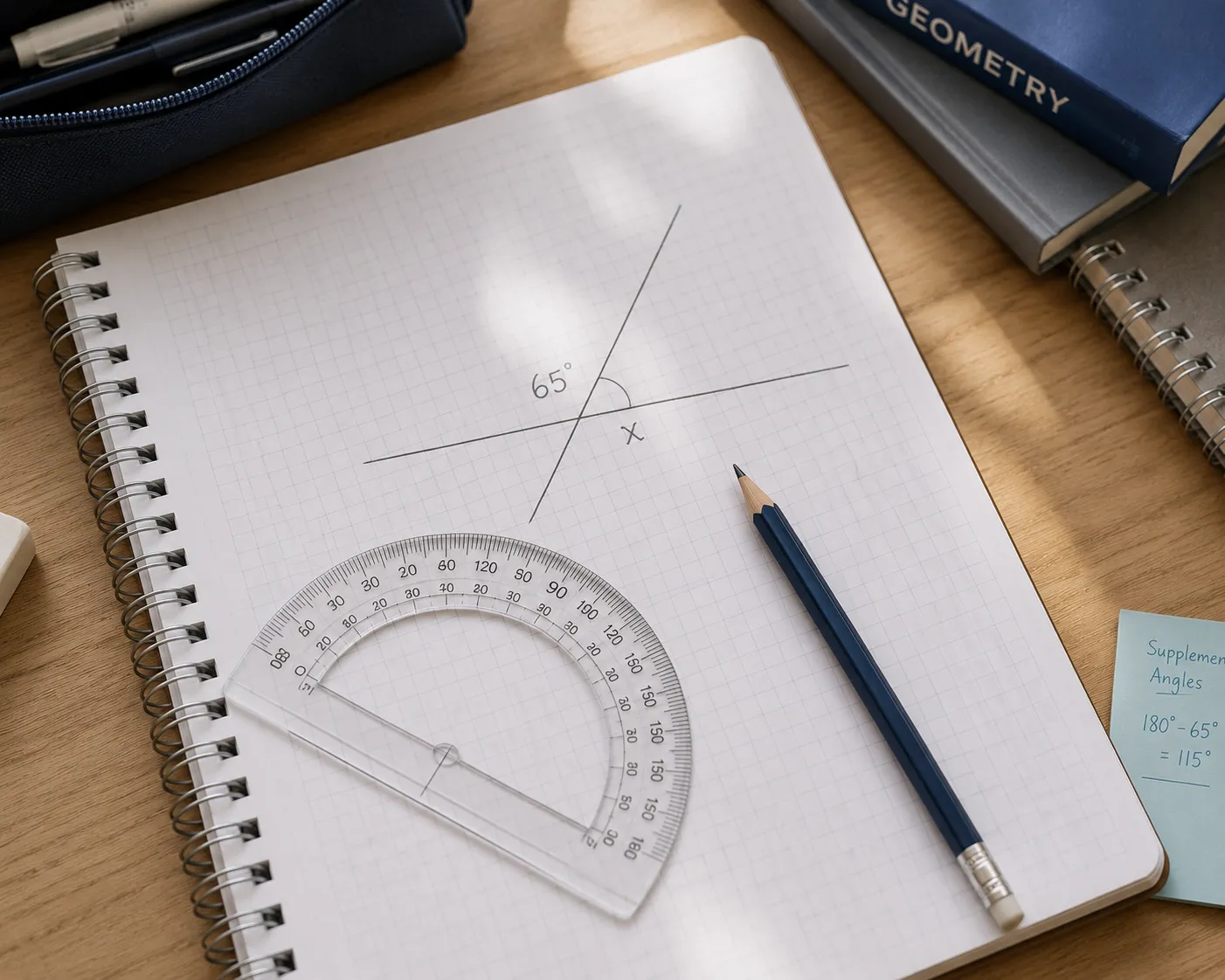
When two straight lines cross, they make four angles. The two angles opposite each other — sharing only the crossing point, not a side — are called vertical angles, and they’re always equal.
Example. Two lines cross, and one of the four angles is 50°. The angle directly across from it is also 50°. The other two angles are each 180° − 50° = 130° (by Rule 1, since each sits on a straight line with the 50°). One given angle, and you’ve found all four.
Rule 4: Complementary and supplementary pairs
Two named pairings show up constantly:
- Complementary angles sum to 90°. If two angles fill a square corner and one is 35°, the other is 90° − 35° = 55°.
- Supplementary angles sum to 180°. If one is 120°, its supplement is 60°.
Supplementary is really Rule 1 wearing a name tag, but textbooks use the vocabulary, so it pays to know it. To keep them straight: C before S, 90 before 180.
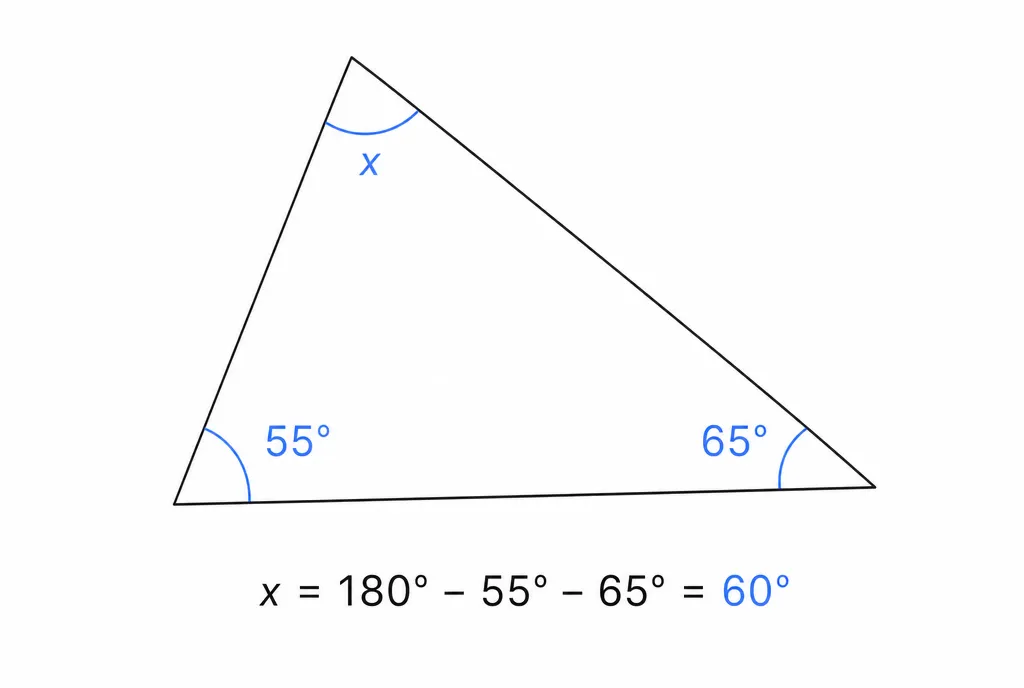
Rule 5: A triangle’s angles sum to 180°
The three interior angles of any triangle — long, thin, lopsided, doesn’t matter — always add to 180°. Know two, and the third is forced.
Example. A triangle has angles of 65° and 48°. The third is 180° − 65° − 48° = 67°. In a right triangle you get one angle free: the right angle is 90°, so the other two must sum to 90° — they’re complementary. There’s more on this one rule, including exterior angles and special triangles, in how to find the angle of a triangle.
Many multi-step problems chain these rules: use vertical angles to hop across a crossing, a straight line to get into a triangle, then the triangle sum to finish. Label every angle you can as you go, and the unknown usually falls out in two or three steps.
When the rules aren’t enough: measure it
Rules only work when the diagram gives you numbers to subtract from. If you’re staring at an angle with no information — a figure in a worksheet with nothing labeled, an angle in a photo, a corner of a real object — you measure instead.
For angles on paper or on screen, an online protractor is the fastest route: drag its two arms onto the angle and read the degrees, no printing or tracing required. For physical surfaces — a ramp, a roof pitch, a mitered corner — rest an iPhone against the surface and let the sensors read the tilt directly.
Once you have one measured angle, the five rules come right back into play: measure a single angle at a line crossing and you know all four. Naming what you’ve found is the last step — a quick pass through the types of angles tells you whether your answer should look acute, right, or obtuse, which is also a handy sanity check: if you calculated 130° but the angle in the diagram looks sharp and pinched, recheck the subtraction.