
How to Find the Angle of a Triangle
The one rule that solves most cases
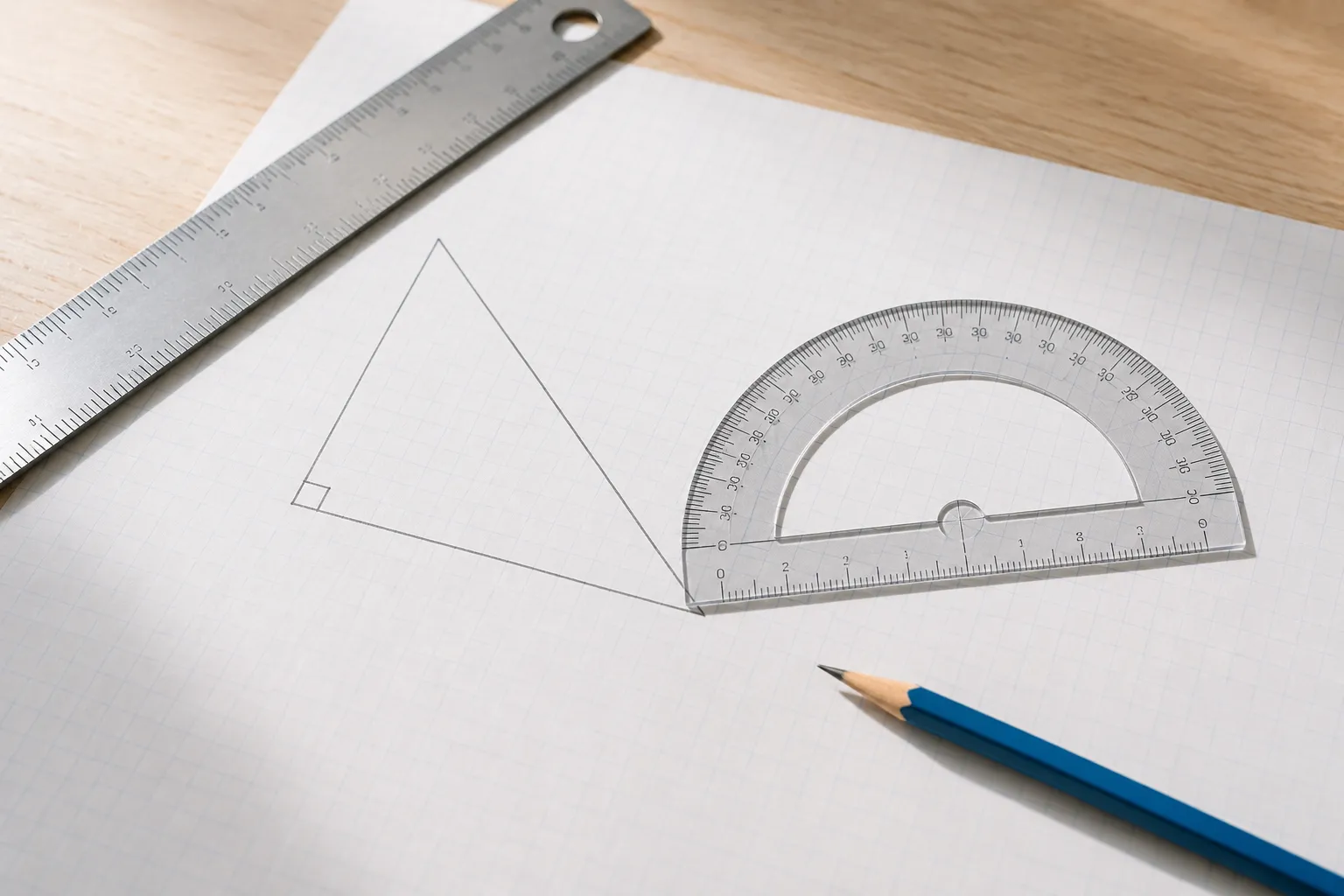
The most useful fact about any triangle is that its three interior angles always add up to 180°. Flat, stretched, lopsided — it doesn’t matter. The sum never changes.
That single rule solves the most common problem outright. If you already know two of the angles, the third is just what’s left over:
missing angle = 180° − (angle one + angle two)
So in a triangle with angles of 65° and 40°, the third angle is 180° − 105° = 75°. Add all three back together (65 + 40 + 75) and you get 180°, which is the quick way to check your work.
You’ll also meet this rule in disguise. A right triangle already spends 90° on its square corner, so the other two angles must share the remaining 90° — they’re complementary. Know one of them and you know the other instantly.
When you only know the sides: SOH-CAH-TOA
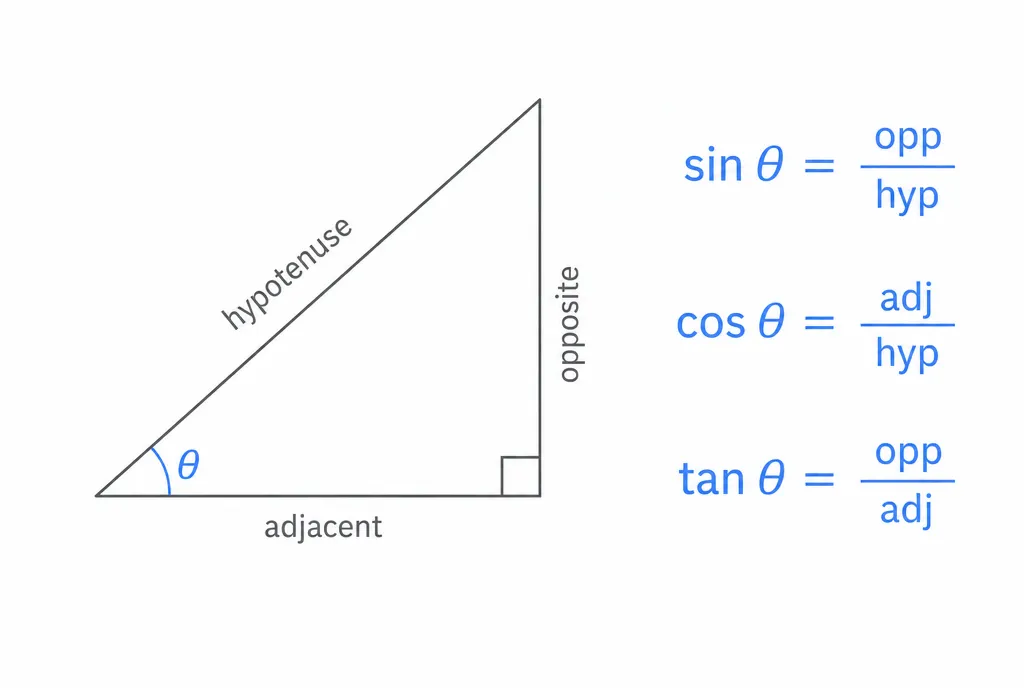
Often you don’t have two angles to subtract from — you have side lengths instead. In a right triangle, that’s exactly when trigonometry earns its keep. The three ratios are bundled into the mnemonic SOH-CAH-TOA, read relative to the angle you’re solving for:
- SOH — sine = Opposite ÷ Hypotenuse
- CAH — cosine = Adjacent ÷ Hypotenuse
- TOA — tangent = Opposite ÷ Adjacent
The opposite side faces your angle, the hypotenuse is the long side across from the right angle, and the adjacent is the remaining side that touches your angle. To turn a ratio back into an angle, you use the inverse functions — written arcsin, arccos, arctan (or sin⁻¹, cos⁻¹, tan⁻¹ on a calculator).
So the angle you want is whichever of these matches the sides you know:
angle = arctan(opposite ÷ adjacent) angle = arcsin(opposite ÷ hypotenuse) angle = arccos(adjacent ÷ hypotenuse)
A worked example
Say a right triangle has a side of length 3 opposite your angle and a side of length 4 adjacent to it. You know the two legs, so tangent is the natural choice:
angle = arctan(3 ÷ 4) = arctan(0.75) ≈ 36.87°
Reach for it, double-check: the other non-right angle is 90° − 36.87° = 53.13°, and 36.87 + 53.13 + 90 lands back on 180°. (This is the famous 3-4-5 triangle, where the hypotenuse comes out to exactly 5.)
One practical note: make sure your calculator is set to degrees, not radians, or the answer will look nothing like what you expect.
General triangles: Law of Sines and Law of Cosines
SOH-CAH-TOA only works when there’s a right angle. For a general triangle with no square corner, two laws take over. Label the sides a, b, c and the angle opposite each side with the matching capital — A, B, C.
The Law of Cosines finds an angle when you know all three sides:
cos C = (a² + b² − c²) ÷ (2ab) so C = arccos((a² + b² − c²) ÷ (2ab))
For example, with a = 5, b = 6, c = 7: cos C = (25 + 36 − 49) ÷ (2 × 5 × 6) = 12 ÷ 60 = 0.2, so C = arccos(0.2) ≈ 78.46°.
The Law of Sines is the partner rule for when you already know one angle and the side facing it: sin A ÷ a = sin B ÷ b = sin C ÷ c. Rearrange it to solve for a second angle, then fall back on the 180° rule for the last one. Together these two laws cover any triangle you can describe with numbers — no right angle required.
Or just measure it
Sometimes you don’t need a formula at all — you need the number in front of you. If you can draw the triangle, you can read its angles straight off a protractor: put the center hole on the vertex, line the baseline up with one side, and read where the second side crosses the scale. (If the idea of degrees and vertices is still fuzzy, our explainer on what the measure of an angle means lays out the vocabulary.)
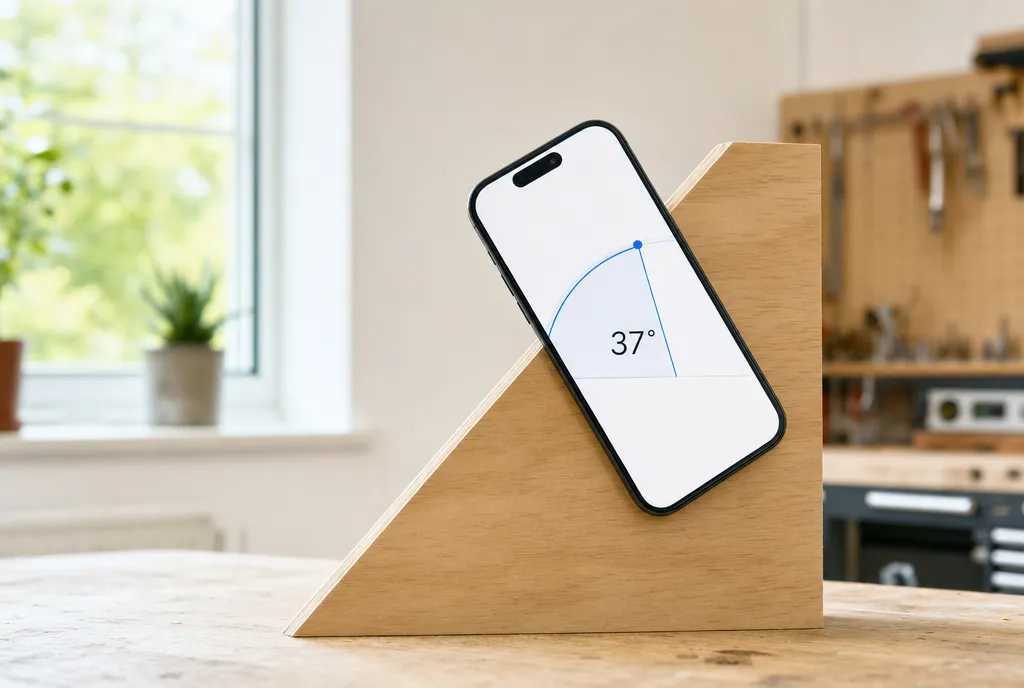
No physical protractor on hand? A free online protractor does the same job in your browser — drop an image of the triangle behind it and drag the arms onto two sides to read the angle between them. And for a triangle that exists as a real object rather than a sketch — a roof truss, a bracket, a ramp — you can rest an iPhone against the edge and let its motion sensors measure the angle directly in degrees.
Calculating and measuring aren’t rivals. The angle sum rule and trigonometry tell you what an angle should be from the numbers you have; a protractor tells you what it actually is on the page or in the world. Whichever you reach for, you now have three reliable ways to find the angle of a triangle.
Frequently asked questions
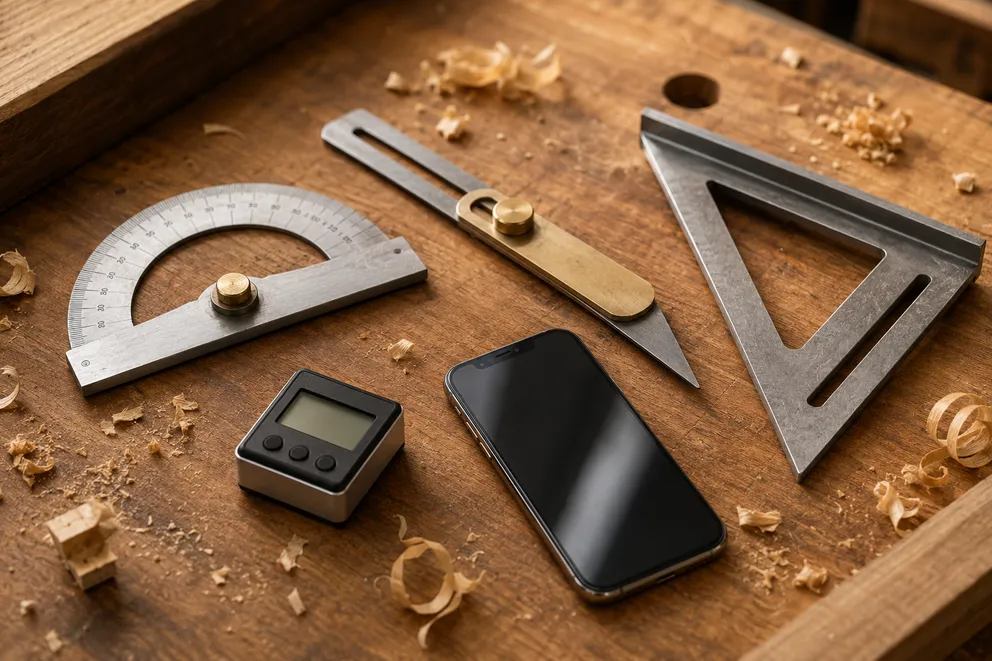
Angle Measuring Tools Compared: Which One Do You Need?
What each angle measuring tool does best — protractor, T-bevel, speed square, digital angle gauge, phone app, online protractor — and how to pick one.
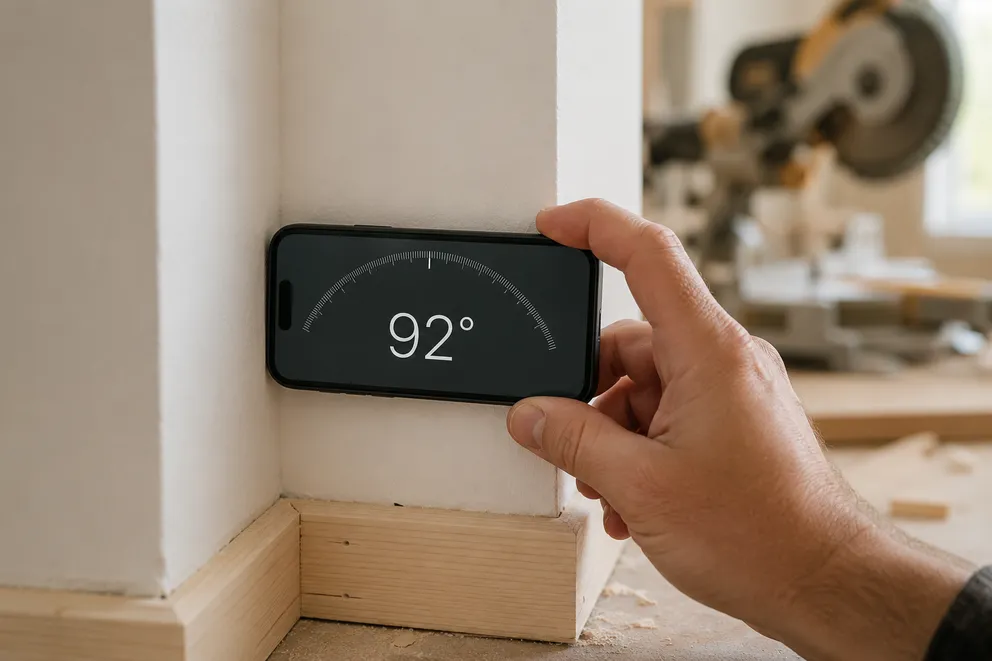
How to Measure the Angle Between Two Walls
Three ways to measure the true angle between two walls — phone with zeroing, T-bevel and protractor, or camera mode — and turn it into the right miter cut.
Measure any angle,
right from your pocket.
Protractor turns your phone into a precision angle finder, level and inclinometer. Measure anything, anywhere.
Download the App