
How to Hang Pictures Perfectly Level (Every Time)
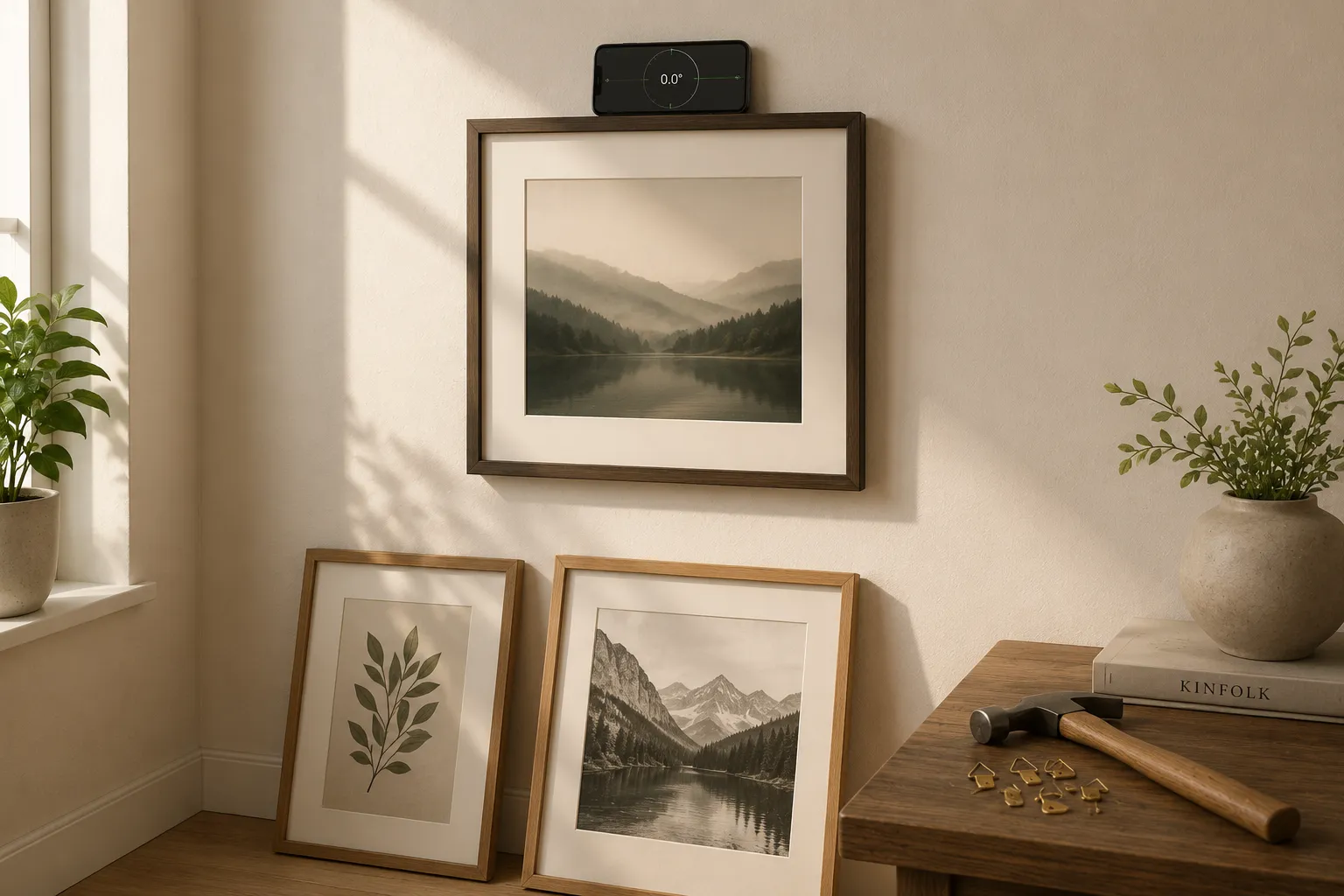
Why frames end up crooked
Two forces conspire against every picture on your wall.
The first is mechanical. A single nail plus a hanging wire is a pivot: the frame hangs from one point and is free to rotate around it. Every slammed door, every footstep on the floor above, every pass of the vacuum nudges it a fraction of a degree. Straight on Saturday, tilted by Thursday.
The second is your own eye. We judge “straight” against nearby reference lines — the ceiling, a door casing, the floor trim. But ceilings and floors are routinely off by a degree or more, especially in older homes. Eyeball a frame parallel to a sloped ceiling and you’ve faithfully copied the slope. The frame is now consistently crooked, which is worse.
The fix for both: measure against true level, and hang so the frame can’t rotate.
The phone-on-the-frame method
Your iPhone’s motion sensors know exactly where gravity points, which makes it a pocket level with a live decimal readout.
- Hang the picture roughly where you want it.
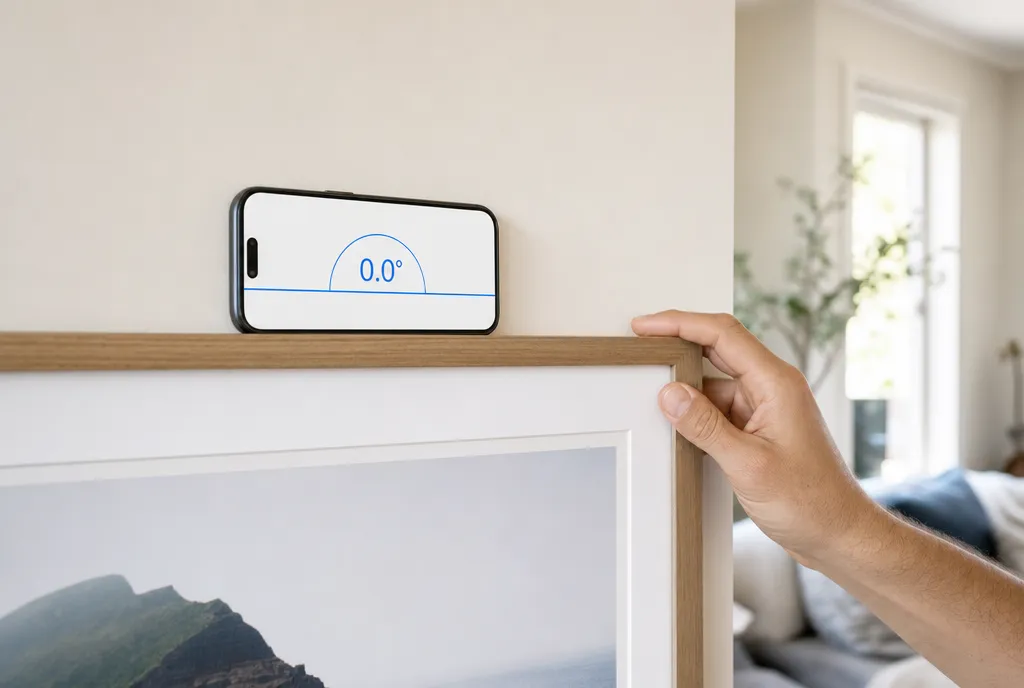
- Rest the phone on the frame’s top edge, long edge down, roughly centered.
- Rotate the frame slowly until the readout hits 0.0°.
- Lift the phone straight off without bumping the frame.
A digital level shows tenths of a degree, which matters here — a frame that’s 1° off is easy to miss up close and obvious from the couch. If your frame’s top edge is ornate or rounded, lay a short ruler or paint stir stick across it and set the phone on that. The same technique works with a bubble level; if you’re using one, here’s how to read it correctly.
Hanging with two hooks
Two hooks kill the pivot problem, but only if both sit at exactly the same height — and “same height” means the same level height, not the same tape-measure distance from the floor.
Measuring up from the floor at two points seems rigorous, but if the floor slopes 1° over the width of the frame, both marks inherit the error and the frame hangs tilted with mechanical precision. Instead:
- Mark the first hook position where you want it.
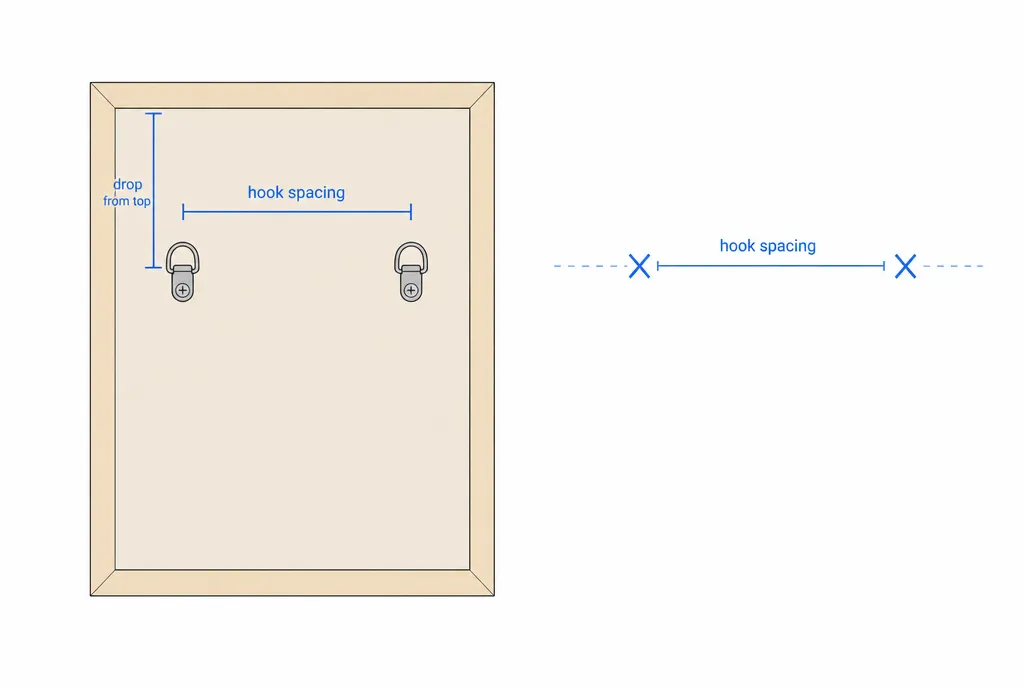
- Hold your phone or level flat against the wall at that mark and extend a true horizontal line across to the second hook position. A long level, a straightedge with the phone on top, or a laser line all work.
- Mark the second hook on that line, at the spacing of your frame’s hangers.
Now the frame hangs from two points on a genuinely level line, and there’s nothing left to rotate around.
Wire vs. sawtooth vs. two D-rings
Hardware determines how long “level” lasts.
- Wire on one hook is the classic — and the worst. Maximum freedom to pivot, plus the wire can slide sideways through the hook over time.
- Sawtooth hangers on one nail are slightly better; the teeth resist sliding but the frame still rotates around a single point.
- Two D-rings on two hooks is the gold standard. The frame is fixed at two points and physically cannot rotate. If a frame matters to you, spend the two dollars and add D-rings.
If you’re stuck with wire, hang it across two hooks spaced a hand-width apart. It’s not as rigid as D-rings, but it dramatically slows the drift.
Gallery walls: level the first, align to it
On a gallery wall, one crooked frame infects its neighbors, because your eye reads every frame against the ones beside it.
Level the first frame with the phone until it reads dead zero — this frame is now your reference. Then align every neighboring frame to it: equal gaps, tops or centers in agreement, phone check on each new frame as you go. Never align to the ceiling, even if the wall sits right under it. A truly level grid under a slightly sloped ceiling looks intentional; a grid that follows the ceiling looks like the whole wall is sliding.
Making it last
Two cheap upgrades keep frames level for years:
- Museum putty (or a felt bumper with a dab of putty) on the bottom corners grips the wall and stops vibration creep on single-hook frames.
- A second hook, as above — the permanent fix.
Level once with the sensor, hang on two points, and you’ll never straighten that frame again.
Frequently asked questions
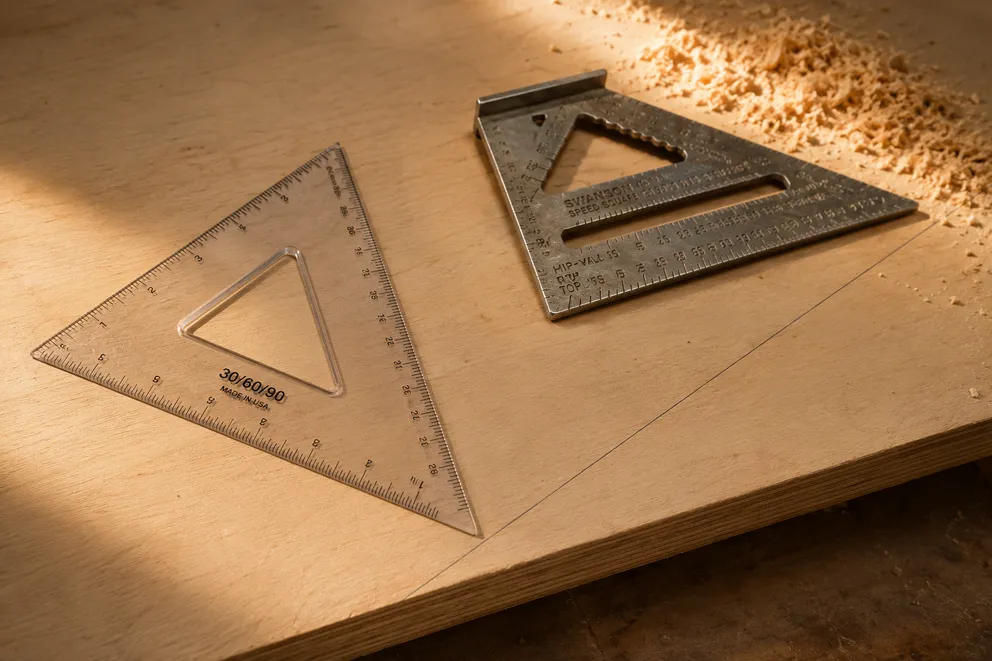
How to Measure (and Mark) a 30-Degree Angle
Four ways to measure and mark a 30-degree angle — protractor, speed square, 30-60-90 triangle, or the 2:1 hypotenuse trick — plus a phone check of the cut.
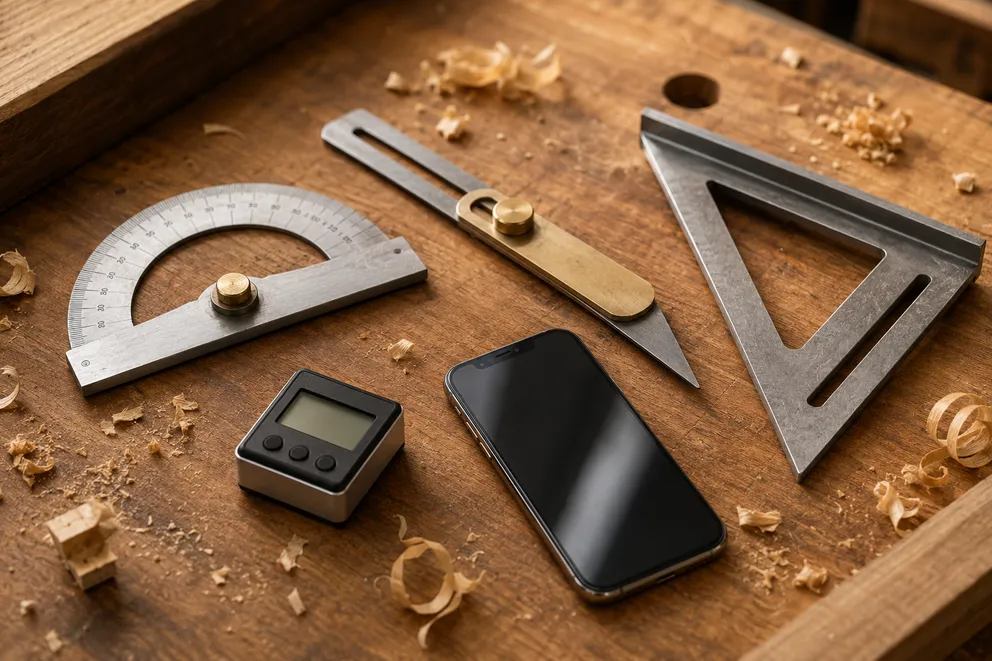
Angle Measuring Tools Compared: Which One Do You Need?
What each angle measuring tool does best — protractor, T-bevel, speed square, digital angle gauge, phone app, online protractor — and how to pick one.
Measure any angle,
right from your pocket.
Protractor turns your phone into a precision angle finder, level and inclinometer. Measure anything, anywhere.
Download the App