
How to Measure (and Check) a Right Angle
What a right angle actually is
A right angle is the corner you get when two lines meet at exactly 90 degrees — a quarter of a full turn. It’s the angle in the corner of a sheet of paper, a picture frame, or a well-built doorway. Mathematically it sits dead center between a flat line (180°) and no angle at all (0°), and it’s the reference every other angle is judged against. Anything smaller is acute; anything larger is obtuse. If you want the full family tree, the types of angles explained post lays them out.
In the workshop, “right angle” and “square” mean the same thing in practice. When a carpenter says a corner is square, they mean the two pieces meet at 90°. The word comes straight from the tool — a square — that checks it. The goal of measuring a right angle is rarely to find out it’s “about 90.” It’s to find out whether it’s exactly 90, because a frame that’s a degree off at each corner ends up visibly crooked by the time you assemble all four.
Checking a corner with a square
The fastest way to check a right angle is a dedicated tool. You’ve got three common ones:
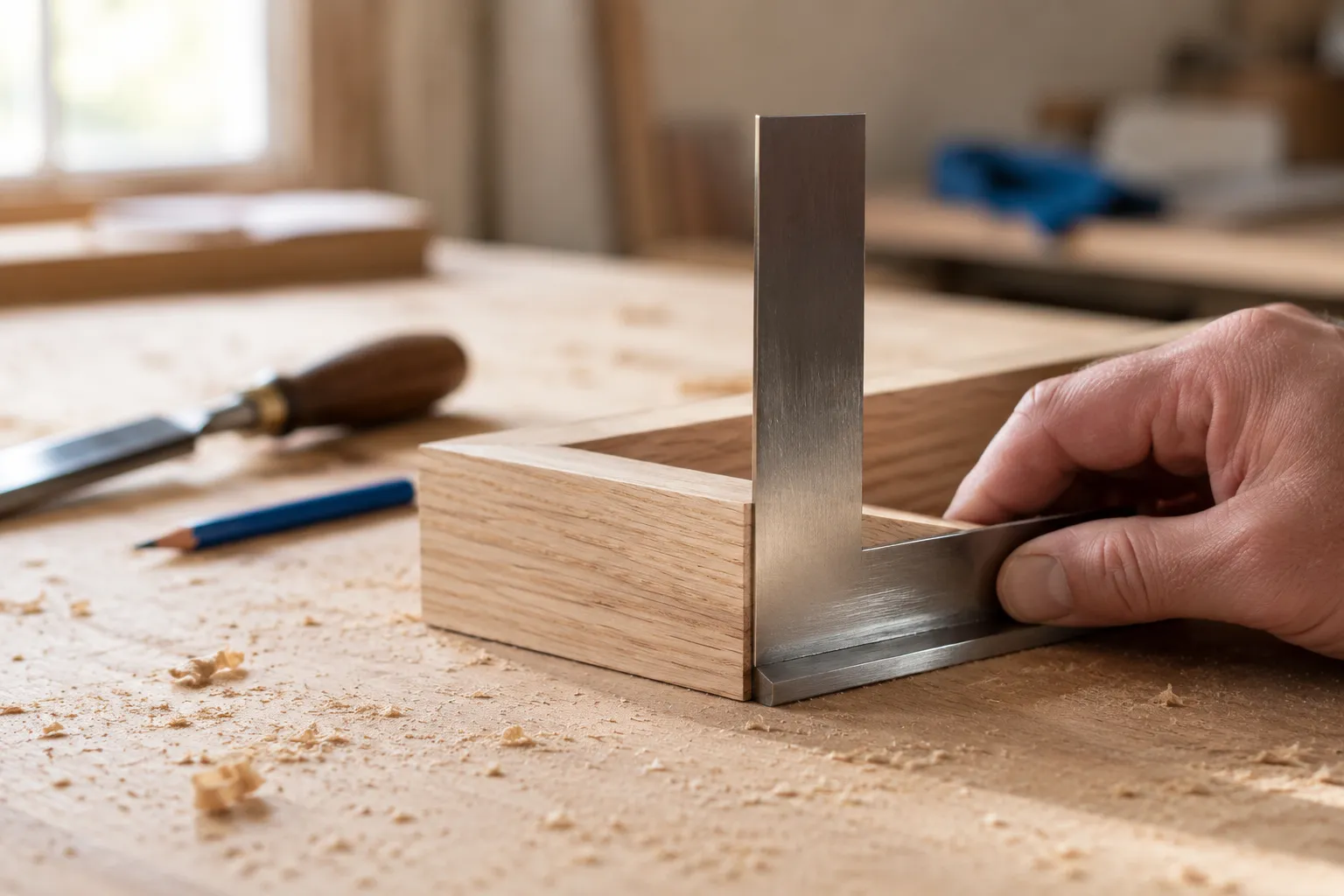
- Try square — a fixed steel blade set permanently at 90° to a wooden or metal stock. Drop the stock against one face and the blade lies along the other. Hold it up to the light: if you see daylight between the blade and the wood, the corner isn’t square.
- Combination square — a sliding head on a ruled blade. It does 90° and 45°, doubles as a depth gauge, and is the everyday workhorse for most DIY.
- Framing (carpenter’s) square — a big L-shaped steel square for checking large joints, wall studs, and sheet goods where a small blade won’t reach.
The technique is the same for all three: seat one edge firmly against one side of the corner, then look for a gap along the other edge. A right angle shows no gap end to end. The light test is more sensitive than your eye alone — a 1° error opens a gap you can actually see at the tip of the blade.
One caveat: cheap squares aren’t always square. Test yours by drawing a line along the blade against a straight edge, flipping the square over, and drawing again. If the two lines diverge, the tool is off and so is everything you’ve checked with it.
The 3-4-5 method for big corners
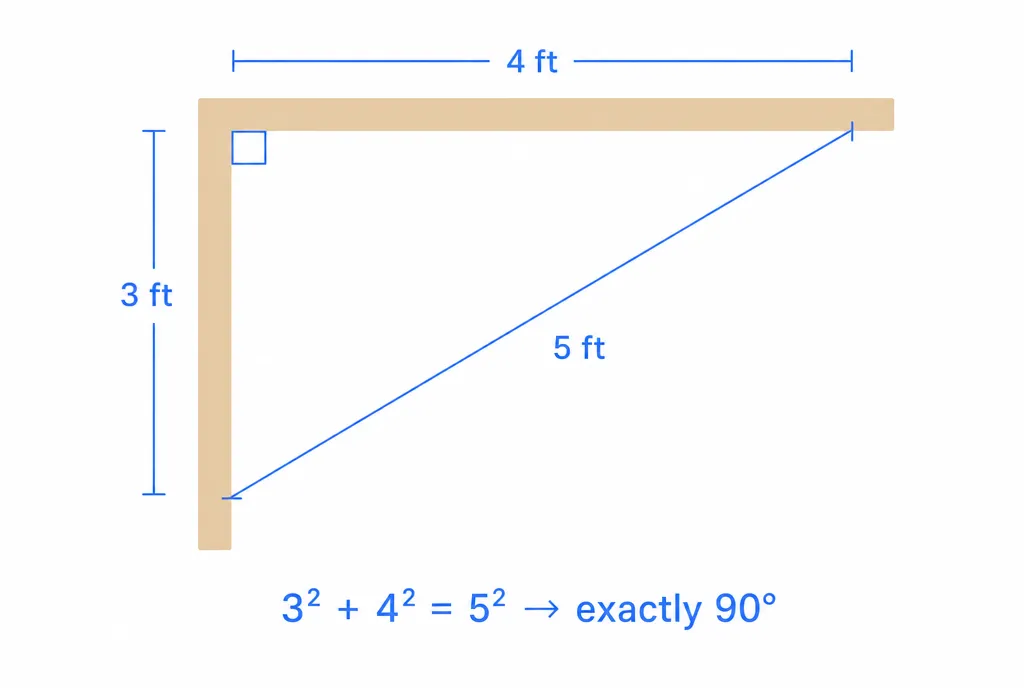
When the corner is too large for a square — a deck frame, a foundation, a wall layout — builders fall back on the 3-4-5 method, which needs nothing but a tape measure. It comes from the Pythagorean theorem: a triangle with sides of 3 and 4 has a diagonal (hypotenuse) of exactly 5 only when the corner between those two sides is 90°.
Here’s how to use it:
- From the corner, measure 3 units along one side and make a mark.
- From the same corner, measure 4 units along the other side and mark that.
- Measure the straight-line distance between the two marks.
- If that diagonal reads exactly 5 units, the corner is a true right angle. If it’s more, the corner is open past 90°; if it’s less, it’s closed up tighter.
The units don’t matter as long as they match — inches, feet, whatever. Bigger is more accurate, so framers scale it up to 6-8-10 or 30-40-50 to check long walls. It’s the most reliable trick in the box for corners no square can reach.
Confirming 90.0° with your phone
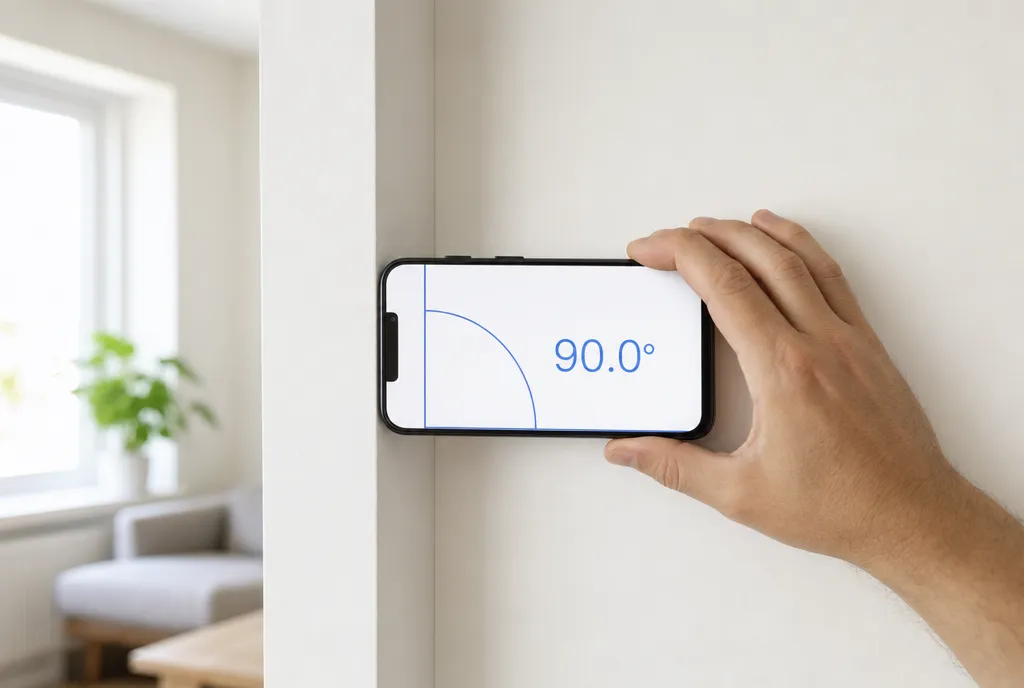
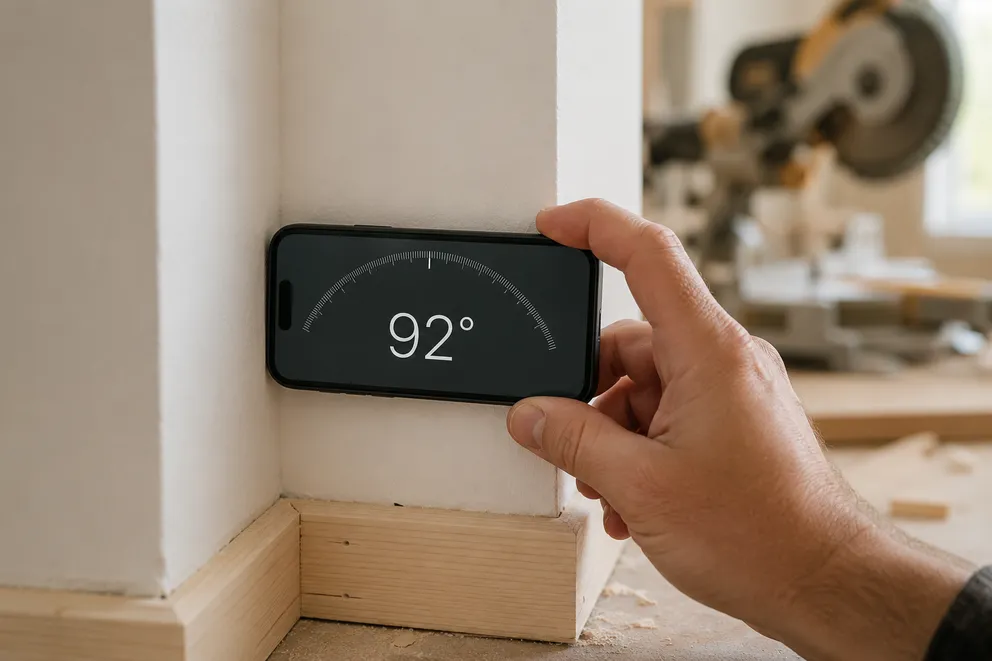
A square tells you square or not; it doesn’t hand you a number. When you want the actual degree reading, your iPhone does it. Its accelerometer and gyroscope sense the direction of gravity, so the phone always knows how far it’s tilted from level — that’s how the built-in level in Apple’s Compass app works.
Rest the phone flat against one side of the corner and zero it, then move it to the adjoining side. The change in reading is the angle between the two faces. A right angle shows up as 90.0°. For a corner you can’t lay a phone against, the measure angle camera mode lets you drag two on-screen arms onto a photo and reads the angle between them.
Be honest about the limits: a phone is accurate to about 1° for DIY work, which is plenty for hanging a shelf or squaring a frame, but it’s not a machinist’s gauge. Re-zero against a reference you trust — a known-good square, or a surface you’ve already checked — before you rely on a reading. The sensors drift, and a quick re-zero against something flat keeps you honest.
Is it 90°, or is it square and plumb?
Here’s a distinction that trips people up. Measuring “is this angle 90°” is not the same as “is this corner square and plumb.” Two boards can meet at a perfect 90° while the whole assembly leans like a fallen domino — the angle is right, but the structure is out of plumb (off vertical) or out of level (off horizontal).
A right angle is purely about the relationship between the two pieces. Plumb and level are about how that corner sits relative to gravity. A door frame needs both: square corners so it doesn’t rack, and plumb sides so the door doesn’t swing open on its own. Check the angle with a square or the 3-4-5 method, then check plumb and level separately — a digital level on your phone reads vertical and horizontal directly.
Common mistakes
A few errors account for most “I checked it and it’s still wrong” moments:
- Trusting an untested square. As above — verify the tool before you verify the work.
- Measuring off a rounded or chipped corner. The square or tape rocks on the high spot and reads a false angle. Clean the edge first.
- Sloppy 3-4-5 marks. A diagonal off by a hair throws the result. Mark with a sharp pencil or knife, and scale up for accuracy.
- Forgetting to re-zero the phone. A reading from a drifted sensor looks authoritative and is quietly wrong.
- Confusing square with plumb. A perfect 90° corner can still be leaning. Check both.
Get the tool right, mark cleanly, and confirm the number when it matters — and a right angle is one of the few measurements you can nail every time.
Frequently asked questions
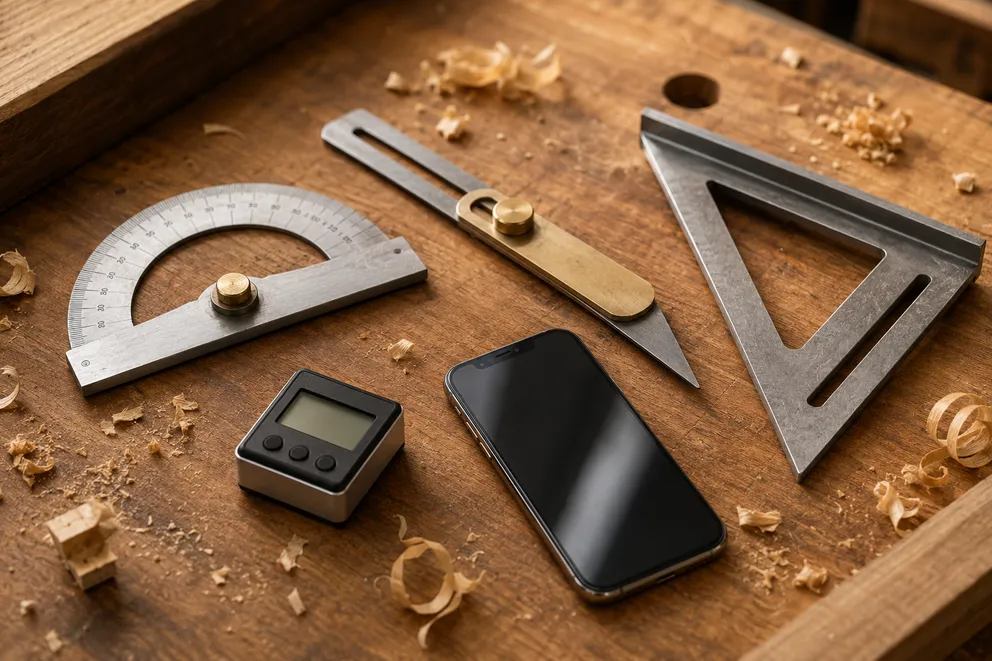
Angle Measuring Tools Compared: Which One Do You Need?
What each angle measuring tool does best — protractor, T-bevel, speed square, digital angle gauge, phone app, online protractor — and how to pick one.
How to Measure the Angle Between Two Walls
Three ways to measure the true angle between two walls — phone with zeroing, T-bevel and protractor, or camera mode — and turn it into the right miter cut.
Measure any angle,
right from your pocket.
Protractor turns your phone into a precision angle finder, level and inclinometer. Measure anything, anywhere.
Download the App