
Goniometer Basics: Measuring Joint Range of Motion
What a goniometer is
A goniometer is, at heart, a protractor with two arms. The word comes from the Greek for “angle measure,” and that is exactly what it does: it reports the angle between two things in degrees. In medicine and physical therapy, those two things are the two segments of a body that meet at a joint — the upper and lower arm at the elbow, the thigh and shin at the knee.
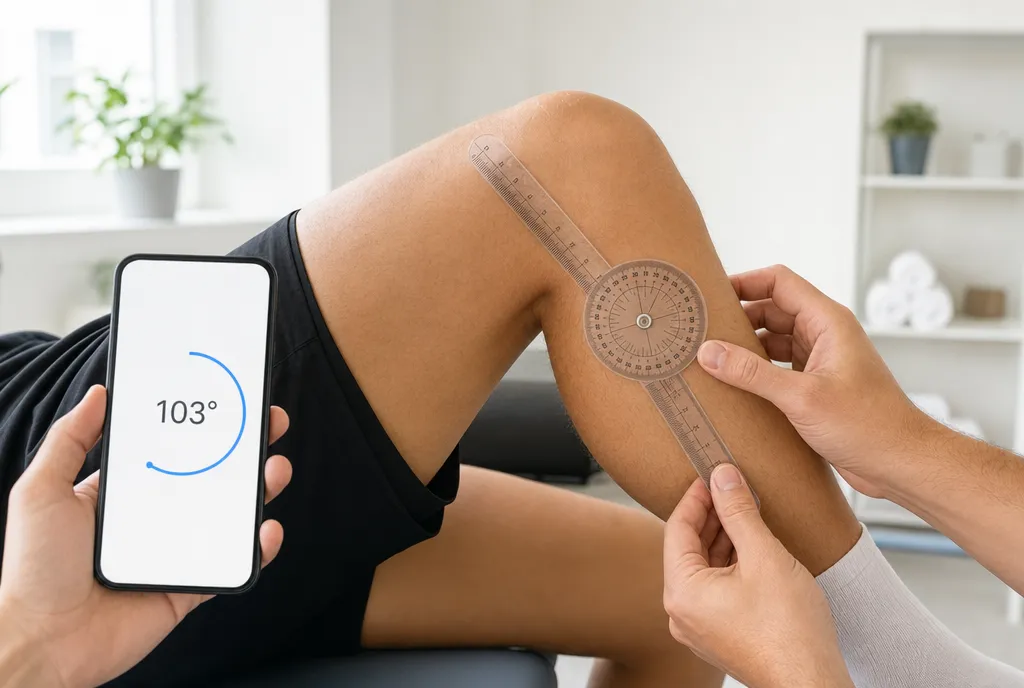
The most common clinical version is the universal goniometer: a clear plastic protractor body with a degree scale, a fixed (stationary) arm, and a movable arm that rotates around a central pivot. The pivot point is called the axis or fulcrum, and it sits over the joint you are measuring. Read the scale where the movable arm lands and you have the joint’s current angle.
That single angle is useful on its own, but the number clinicians actually care about is range of motion, or ROM — how far a joint can travel from one extreme of a movement to the other.
What range of motion means
A joint does not sit at one fixed angle; it sweeps through a range. Your elbow can fold almost shut and can straighten to nearly a flat line. Range of motion is the size of that sweep, measured in degrees.
Two terms come up constantly:
- Flexion — bending the joint, decreasing the angle (curling the forearm toward the shoulder).
- Extension — straightening the joint, opening the angle back out.
ROM is the span between the most-flexed position and the most-extended position. If an elbow bends to 145° of flexion and straightens fully, that arc is its range. After an injury or surgery, the arc shrinks, and the goal of rehab is usually to win those degrees back. Tracking the number over weeks is how a therapist sees whether things are improving, stalling, or going backward.
How a manual goniometer is used
Using a universal goniometer is a careful, deliberate process. The broad steps are consistent across joints:
- Place the axis over the joint. Position the goniometer’s pivot directly over the joint’s center of rotation — the point the limb actually rotates around. Get this wrong and every reading drifts.
- Align the stationary arm. Lay the fixed arm along the limb segment that stays put, pointing it at a fixed bony landmark for reference.
- Align the movable arm. Lay the moving arm along the segment that swings, again aimed at a consistent landmark.
- Read the degrees. Where the movable arm crosses the scale is the joint’s current angle.
- Measure both ends. Take one reading at full flexion and another at full extension.
The difference between those two readings is the range of motion. Bend the knee as far as it goes, read it; straighten as far as it goes, read it; subtract. The consistency of where you place the axis and arms matters more than any single reading — which is why clinicians repeat the same landmarks every visit.
How a phone works as a digital goniometer
A goniometer reads angles, and a modern phone is very good at reading one particular angle: its own tilt relative to gravity. The accelerometer and gyroscope sense which way down is, so the phone always knows how far it is leaning. An app that surfaces this acts as a digital inclinometer — and an inclinometer can stand in for one arm of a goniometer.
The technique mirrors the manual version, but instead of two physical arms you use the phone against each segment in turn:
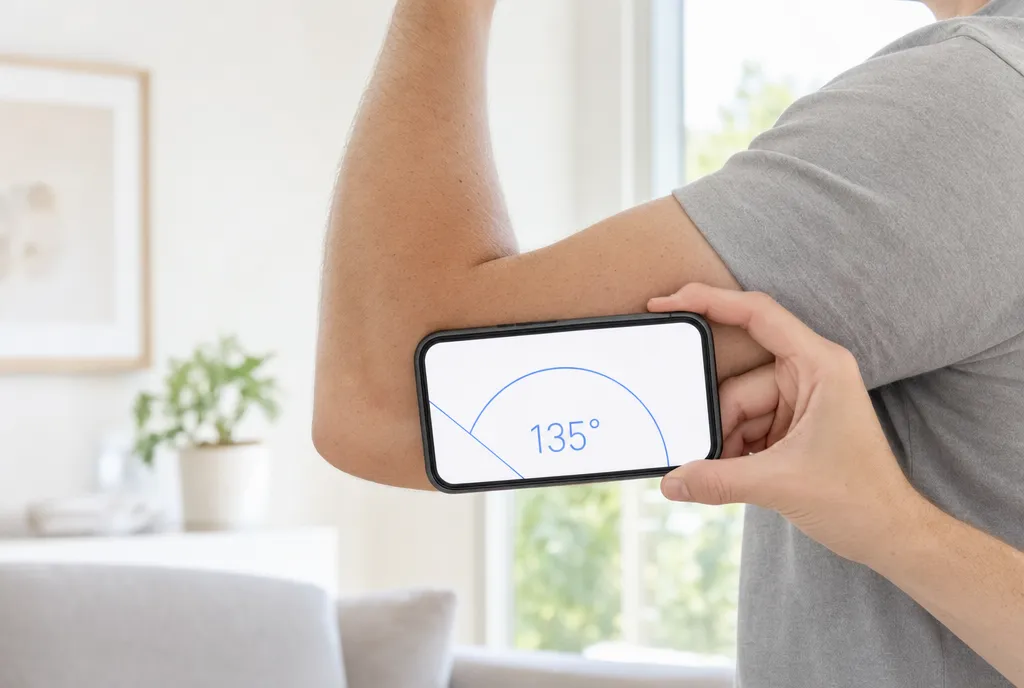
- Rest or align the phone flat along the stationary limb segment and note its angle — often you zero it here so this becomes your baseline.
- Move the joint and align the phone along the moving segment at full flexion. Read the angle.
- Repeat at full extension.
- Subtract the two readings to get the range of motion.
Because the phone reads tilt directly, there is no scale to misread and no pivot to keep perfectly centered — the alignment along each segment is what you have to get right. For someone tracking their own progress between appointments, that convenience is real: it is the same idea behind using a phone as an angle finder, pointed at a joint instead of a shelf. If you want the broader picture of how sensor-based angle reading works, the how it works page walks through it.
Accuracy, limits, and a word of caution
A phone’s tilt sensor is genuinely precise — held still, it resolves angles to roughly a degree, and you can measure an angle repeatably. But sensor precision is the easy part. The real sources of error in any goniometry are human: how you find the joint’s true center, how squarely you align each segment, how soft tissue shifts under pressure, and whether you measure the same way every single time. Those variables dwarf anything the chip contributes.
This matters because ROM numbers carry weight. They inform rehab plans, return-to-sport calls, and judgments about whether a joint is healing. A phone is excellent for spotting your own trend — “my knee bends further than it did last week” — but it is not a clinical instrument, and a one-off reading taken with shaky alignment can mislead.
So treat this article as general information, not medical advice. If a measurement will inform treatment, recovery, or any health decision, it should be taken or verified by a qualified professional using a calibrated device and proper technique. Use a phone to stay curious and motivated between visits — and let the experts make the calls that count.
Frequently asked questions
How to Measure (and Mark) a 30-Degree Angle
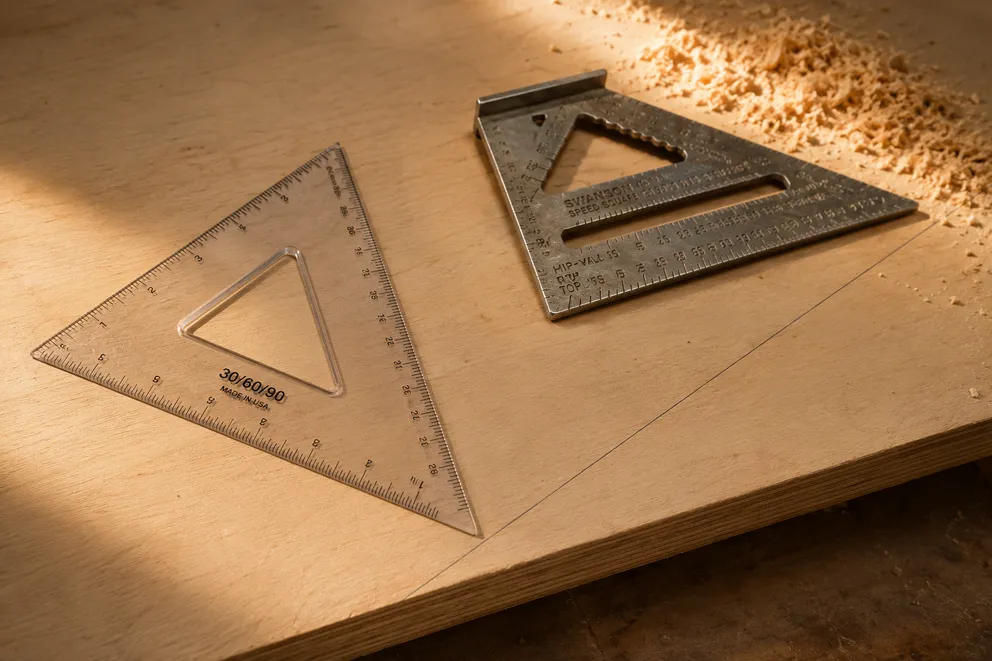
Four ways to measure and mark a 30-degree angle — protractor, speed square, 30-60-90 triangle, or the 2:1 hypotenuse trick — plus a phone check of the cut.
How to Hang Pictures Perfectly Level (Every Time)
Why frames end up crooked, how to level them with the phone-on-the-frame trick, hanging with two hooks, and keeping a gallery wall straight for good.
Measure any angle,
right from your pocket.
Protractor turns your phone into a precision angle finder, level and inclinometer. Measure anything, anywhere.
Download the App