
What Is the Measure of an Angle? (How to Find It)
What “the measure of an angle” means
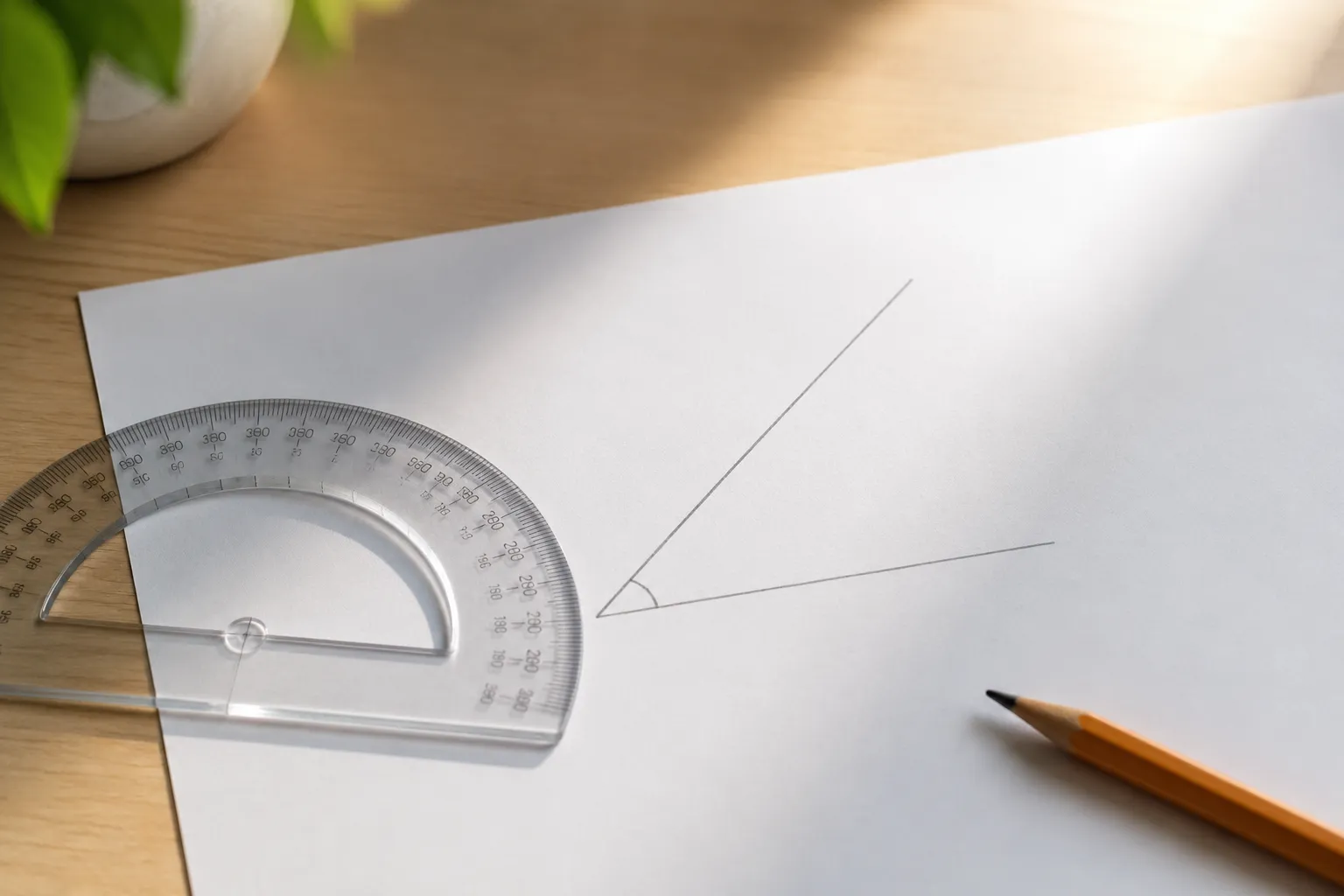
Two lines meet at a point and open away from each other. The measure of the angle is a number describing how wide that opening is — nothing more. Lines almost touching make a small angle; lines pointing in opposite directions make the widest flat angle, 180°.
The point where the lines meet is the vertex, each line is a ray, and the measure is read from one ray around to the other. Crucially, the measure depends only on the opening, not on how long you draw the rays — a wide angle drawn with short lines has the same measure as the same angle drawn huge.
The units: degrees and radians
Two units describe an angle’s measure:
- Degrees (°) — the everyday unit. A full turn is 360°, a square corner is 90°, a straight line is 180°. This is what protractors, tools, and apps show.
- Radians — the unit used in higher math and programming. A full turn is 2π radians (about 6.28). One radian is roughly 57.3°.
For nearly everything outside a trig class, degrees are what you want. If you’d like the reference angles spelled out, see angle degrees explained.
How to find the measure of an angle
There are three dependable methods, from no-math to some-math.
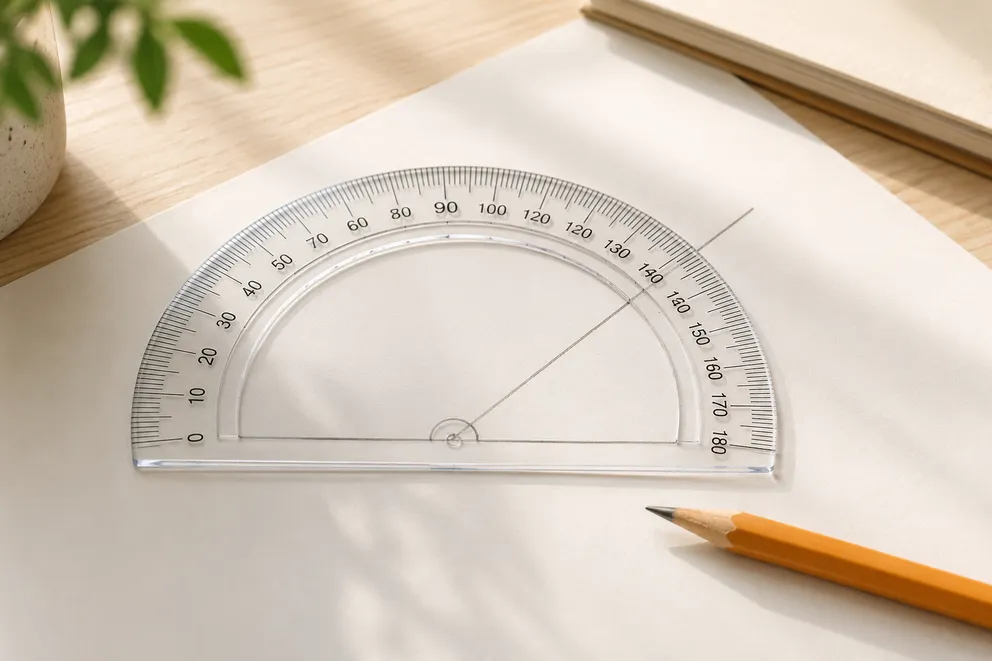
Read it with a protractor. Put the center on the vertex, align the baseline with one ray, and read where the second ray crosses the scale — using the scale that starts at 0° on your aligned ray. Walkthrough: how to use a protractor. No printout handy? The online protractor does the same on screen.
Measure it directly. Rest an iPhone on the surface and the app reports the tilt as degrees — no aligning, no math. This is the fastest route for real-world angles and the basis of every digital angle finder. See the full method in how to measure an angle and the tools that measure angles.
Calculate it with trigonometry. If you can’t reach the angle but you know two side lengths of the triangle it forms, the inverse trig functions give the measure. For a right triangle, tan(angle) = opposite ÷ adjacent, so angle = arctan(opposite ÷ adjacent). It’s the long way around, but it’s how you find an angle you can only measure indirectly.
Naming an angle by its measure
Once you know the measure, you know the name:
- Acute — under 90°
- Right — exactly 90°
- Obtuse — between 90° and 180°
- Straight — exactly 180°
- Reflex — over 180°
That naming doubles as a sanity check. If your protractor says 40° but the angle looks wider than a square corner, you read the wrong scale — the measure and the picture should always agree.
Frequently asked questions
How to Use an Angle Finder (Manual & Digital)
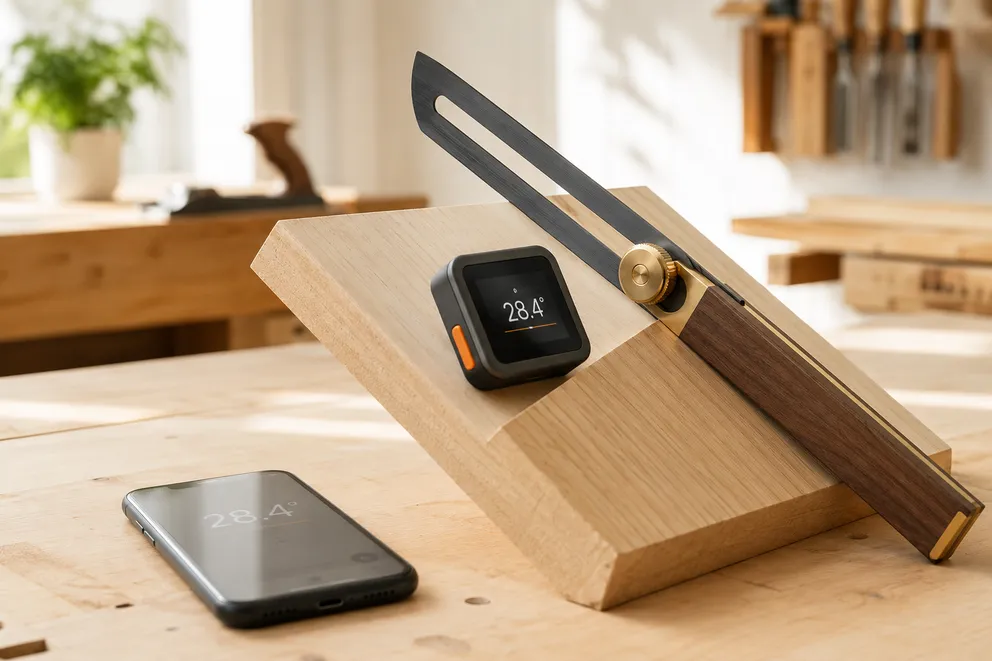
How to use an angle finder step by step — sliding bevels, digital angle gauges, and the angle finder app on your phone — so you read or transfer any angle correctly.
Angle Degrees Explained: How Angles Are Measured
What a degree really is, the angles worth memorizing, and how to read angle degrees with a protractor or your phone — a plain-English guide to measuring angles.
Measure any angle,
right from your pocket.
Protractor turns your iPhone into a precision angle finder, level and inclinometer. Measure anything, anywhere.
Download the App