
Angle Degrees Explained: How Angles Are Measured
What a degree actually is
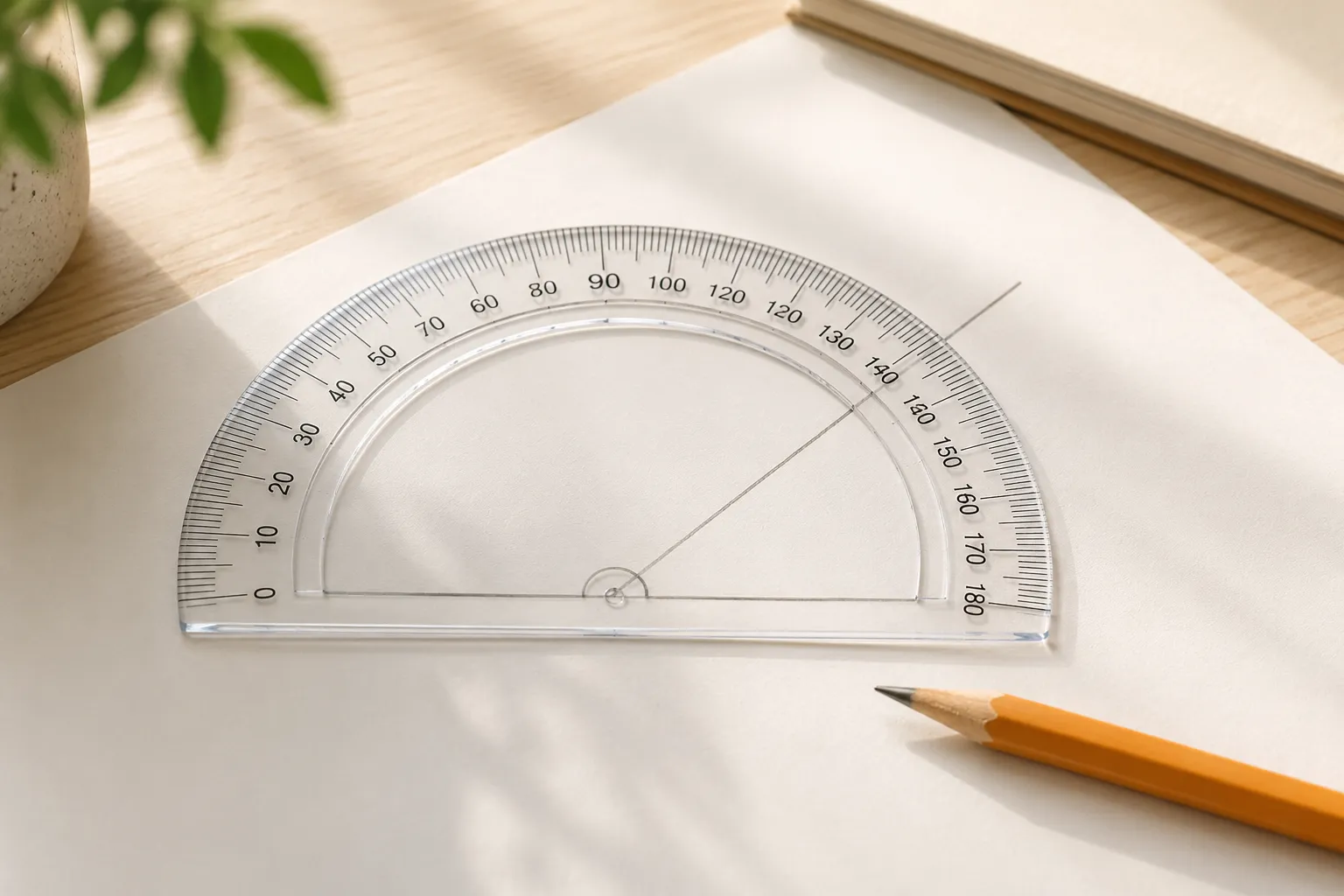
Angles are measured in degrees because someone, a very long time ago, decided to split a full turn into 360 equal slices. Spin all the way around and you’ve traveled 360°; a quarter of that turn is 90°; half of it is 180°. One degree is just one of those 360 slices — small, but it adds up.
Why 360 and not 100? The number comes from ancient Babylonian astronomy and the fact that 360 divides cleanly into halves, thirds, quarters, fifths, sixths, and more. That’s why so many everyday angles land on round numbers.
The angles worth memorizing
You don’t need to recall hundreds of values — just a handful of anchors:
- 0° — the two lines lie on top of each other.
- 45° — a perfect diagonal, exactly half of a square corner.
- 90° — a right angle, the square corner of paper, walls, and picture frames.
- 180° — a straight line; the two rays point in opposite directions.
- 360° — a full rotation, back to the start.
Once those are in your head, you can eyeball almost any angle to within a few degrees. A reading that’s wildly off your estimate is usually a misread, not a surprise.
Types of angles by degree
Angles get names based on how big they are, and the names map directly to ranges of degrees:
- Acute — less than 90°. Sharp and narrow.
- Right — exactly 90°. The square corner.
- Obtuse — between 90° and 180°. Wide and open.
- Straight — exactly 180°. A flat line.
- Reflex — more than 180° but less than 360°. The “outside” of a normal angle.
Knowing which bucket an angle falls into is the fastest sanity check there is: if you measured 150° but the angle clearly looks sharper than a square corner, you read the wrong scale.
How to measure degrees
There are two reliable ways to turn an angle into a number.
With a protractor. Place the center hole over the vertex, align the baseline with one ray, and read the degree mark where the other ray crosses — using the scale that starts at 0° on your aligned ray. The full walkthrough is in how to use a protractor. You can also try it without paper using the online protractor, which shows the degrees live as you drag.
With your phone. Every modern iPhone has motion sensors that know how far it’s tilted from level. Rest the phone on a surface and that tilt is the surface’s angle in degrees — the same idea behind a digital angle finder. For the full method on real-world surfaces, see how to measure an angle and the tools that measure angles.
Degrees, percent, and ratio
Degrees aren’t the only way to describe how steep something is. The same 26.57° slope can be written as a 50% grade, or as a 6-in-12 ratio the way roofers do. They’re three languages for the same angle, and a good measuring tool switches between them so you don’t have to convert by hand. That’s exactly what makes one reading useful for geometry homework, a wheelchair ramp, and a roof pitch all at once.
The takeaway: a degree is a simple thing — one slice of a turn into 360 — and once the reference angles are familiar, reading any angle is mostly a matter of pointing the right tool at it.
Frequently asked questions
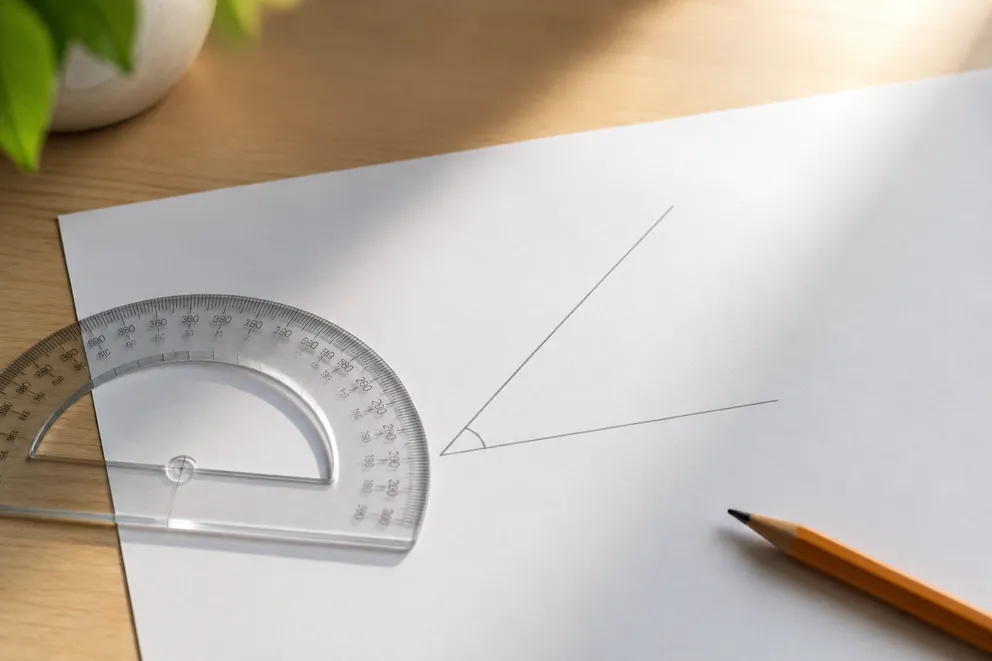
What Is the Measure of an Angle? (How to Find It)
What the measure of an angle means, the units it's given in, and three ways to find it — with a protractor, with your phone's sensors, or with simple trigonometry.
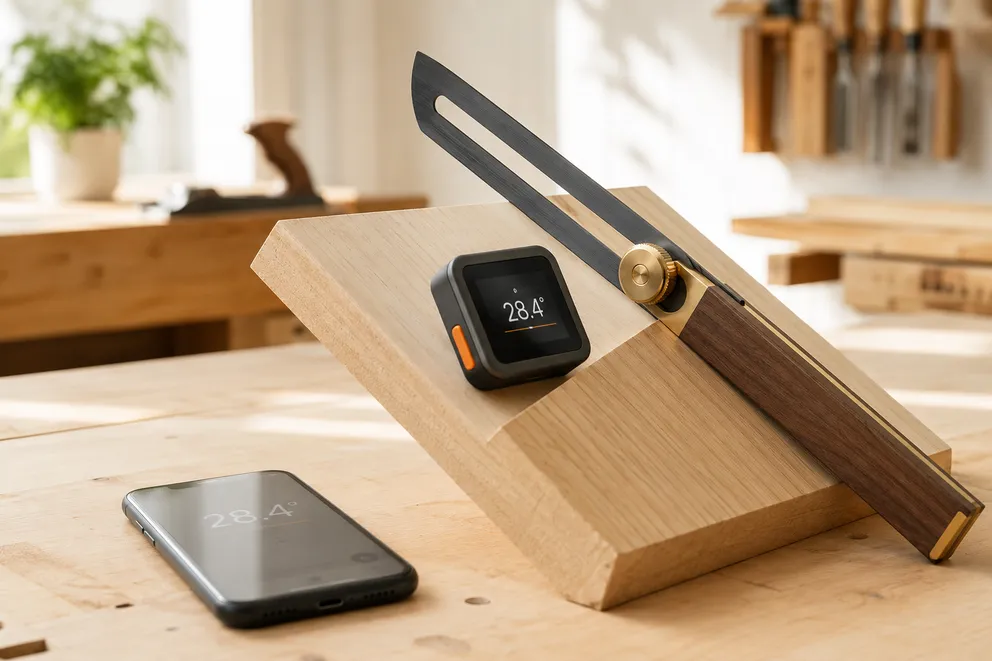
How to Use an Angle Finder (Manual & Digital)
How to use an angle finder step by step — sliding bevels, digital angle gauges, and the angle finder app on your phone — so you read or transfer any angle correctly.
Measure any angle,
right from your pocket.
Protractor turns your iPhone into a precision angle finder, level and inclinometer. Measure anything, anywhere.
Download the App