
Types of Angles Explained (Acute, Right, Obtuse & More)
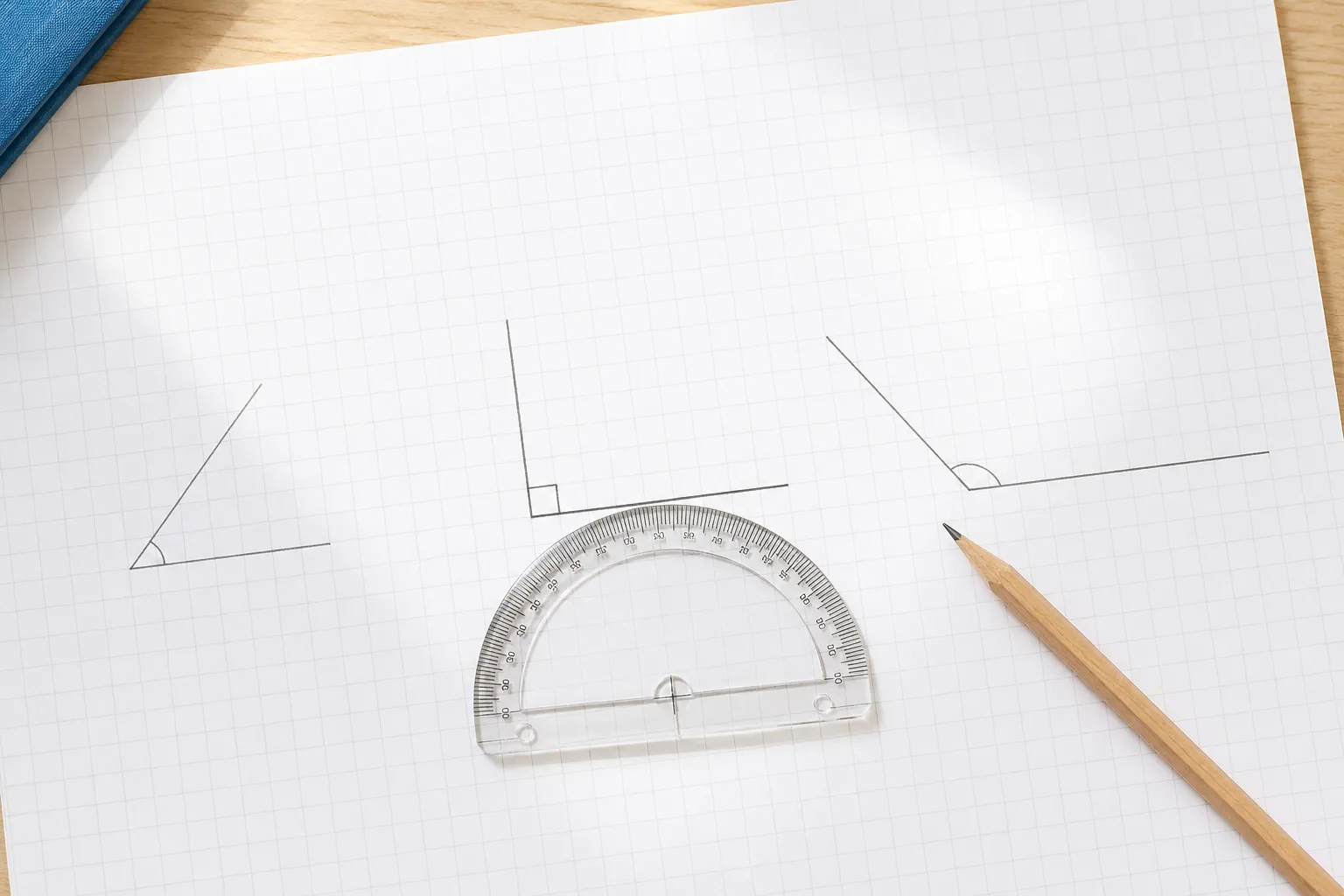
What makes one angle different from another
An angle is the opening between two rays that meet at a point called the vertex. The size of that opening is measured in degrees, running from 0° (the rays sitting on top of each other) all the way around to 360° (a full turn back to the start). Every type of angle is just a slice of that range with its own name.
That means the types of angles aren’t about shape, color, or how the lines are drawn — they’re about a single number. Once you know the degree measure, the name follows automatically. A 45° opening is acute whether it’s a slice of pizza or the corner of a kite. So the whole topic comes down to learning a handful of boundaries: 90°, 180°, and 360° are the dividers, and the named types live between them.
Acute, right, and obtuse: the everyday three
These three cover almost every angle you’ll meet day to day, and they’re defined by the first major boundary at 90°.
An acute angle is anything less than 90° — a tight, sharp opening. Think of the hands of a clock at 1 o’clock, the point of a slice of pizza, or the splayed legs of an open pair of scissors just starting to close. If it looks pinched, it’s acute.
A right angle is exactly 90°: a perfect square corner. The corner of a sheet of paper, a window frame, the join where a wall meets the floor — all right angles. It’s the single most important angle to memorize, because every other type is described in relation to it.
An obtuse angle is wider than 90° but less than 180° — open and relaxed, but still clearly bent. A reclining chair tilted back, the angle of an open laptop, or the hands of a clock at 8 o’clock are all obtuse. The moment the opening flattens into a straight line, it stops being obtuse.
Straight, reflex, and full: the bigger openings
Past 90° the angles keep growing, and three more names mark the way.
A straight angle is exactly 180°. The two rays point in opposite directions and form a single straight line through the vertex — a flat horizon, a level tabletop edge, or the hands of a clock at 6 o’clock. It’s easy to forget this counts as an angle at all, but it’s the dividing line between everything below it and the reflex angles above.
A reflex angle is bigger than 180° but less than 360°. This is the “outside” of a more familiar angle — if a corner opens 60° one way, the reflex angle going the long way around is 300°. You see reflex angles in the wide sweep of a recliner pushed all the way back, or in the larger arc when a door swings open well past flat.
A full angle (also called a complete angle) is exactly 360° — one complete turn, all the way around until the rays line up again where they started. A spinning top that makes a full rotation, or the second hand of a clock sweeping once around the face, traces a full angle.
Telling them apart at a glance
You don’t need a tool to classify most angles — you need a reference, and the best one is a square corner. Hold up the corner of a book, a phone, or a sheet of paper, and compare:
- Tighter than the corner? Acute (under 90°).
- Matches the corner exactly? Right (90°).
- Wider than the corner, but still bending? Obtuse (90–180°).
- Flattened into a straight line? Straight (180°).
- Bent so far it’s curling back around? Reflex (180–360°).
This eyeball test gets you the right category almost every time. When you need the exact number — say the obtuse angle on a shelf bracket is 105° or 115° — that’s where measuring comes in. You can rest an iPhone against the surface and let its sensors read the tilt, or drop two arms onto a photo with an online protractor and read the degrees directly. The category tells you what kind of angle it is; the measurement tells you exactly which one.
A quick note on a related idea you’ll often see alongside these types: complementary angles are two angles that add up to 90°, and supplementary angles are two that add up to 180°. Those describe a relationship between two angles rather than naming a single angle’s type — handy to recognize, but separate from the six categories above.
Quick-reference list
Here are all the types of angles by their degree measure, in order:
- Acute angle — less than 90° (sharp, pinched openings)
- Right angle — exactly 90° (a square corner)
- Obtuse angle — between 90° and 180° (open but still bent)
- Straight angle — exactly 180° (a straight line)
- Reflex angle — between 180° and 360° (the long way around)
- Full angle — exactly 360° (one complete turn)
If you’d like to go deeper on what a degree actually represents, see what a degree means and where the 360° system comes from. And if you’re less sure how the measure of an angle is found in the first place — what that single number is really counting — start with the measure of an angle. Together they turn these names from things to memorize into ideas that make sense at a glance.
Frequently asked questions

How to Measure an Angle Without a Protractor
No protractor? Measure an angle with your phone, simple trigonometry, or a folded sheet of paper. Practical methods that work for school, DIY, and woodworking.
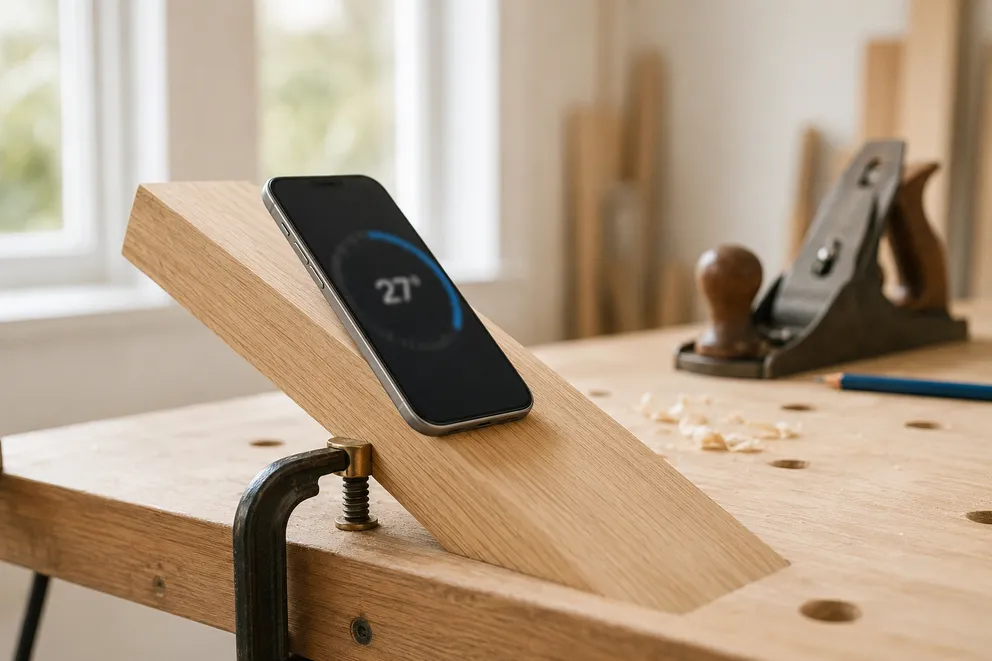
How to Measure an Angle With Your iPhone
Measure any angle with your iPhone using its built-in motion sensors and camera — no physical protractor needed. A step-by-step guide for surfaces, slopes, and photos.
Measure any angle,
right from your pocket.
Protractor turns your iPhone into a precision angle finder, level and inclinometer. Measure anything, anywhere.
Download the App